
The Dark, Silent Vault: Discovering the Unique Wiring Inside Your Skull
The above quote is spot on!
But the question is: What is "yourself?"
In the most generic sense, it is simply you, your body, and brain moving through the world, and therefore it is more of a blanket statement to just believe in yourself.
It reminds me of the quote from Anthony Pompilano: I am willing to bet on myself any day of the week." He is not speaking from hubris but rather the sense of belief in his ability to "figure it out," the it being whatever is thrown in front of him.
I think there is a more granular and focused way to look at "believe in yourself" that provides a much better compass for what to believe in, rather than a blanket belief. And it gets at the issue of the word "yourself," or who you really are.
We are all born with a brain with 86 billion cells, all connected to each other by 100 trillion connections. Within that beautiful and staggeringly amazing neurological kingdom of yours, there is a genetic and wiring signature that is uniquely you, just waiting to be discovered.
But many people never fully make that discovery. Why?
Programming.
Layer 1: programming by your family of origin. Here, you get core operating system with all the beliefs, ideas, anxieties, and perspectives of your parents or caregivers relentlessly inserted into your brain, like it or not. Plus, you are steeped in the emotional and relational landscape that has been previously embedded in your caregivers' brains.
Layer 2: programming by the culture you live in. In the USA, we drink the Kool-Aid of individualism, pulling oneself up by the bootstraps, and the promise that hard work will lead to success, meaning money and status.
Layer 3: your career, especially if you follow a well-prescribed path such as becoming a surgeon, or a similar career with a scripted path to success. Over time, as you become a surgeon (for example), you are programmed with the ways of thinking and seeing the world as a surgeon.
The bottom line is well established: we slowly adapt and mold to the environment we are in. We become one of them.
Not that this is bad. It depends. On what you are being programmed with, and whether it fits you and your unique neurological wiring.
But here is the thing: from my own personal experience (lot's of it), from my extensive reading and studying this topic of who "yourself" is, and from my work coaching, I have come to realize that one of the greatest personal tragedies that I see play out again and again is how everyone of us can lose "yourself," if, that is, we ever had any real awareness or understanding of what our own "yourself" is.
In other words, do you have a good feel for your unique neurological wiring that is locked inside the dark, silent vault of your skull, waiting to be discovered? Most of us trundle along through life vacuuming up the programming of our childhood, culture, and career, filling the dirt bag up with programs of the outside world while only moderately aware of the unique impulses generated by the unique 100 trillion connections of our brain cells that make each of us staggeringly unique.
We are all the same in many ways. We are humans. We have emotions. We have sensations. Etc.
But where we are all different is in how the information from all of our sensory inputs is processed by that one-of-a-kind neurological configuration and then put together to provide you, and only you, with your unique perspective and drives.
This whole situation is most obvious if you have children. How many times have you heard this phrase in some form or another: "I have 6 kids, and you would think that, given the fact that they all came from the same parents, they would be more similar. But they aren't - my God I can't believe how different they are. It's like each of them came from different parents!"
Then, as these six kids are programmed along the way, the things that make each of them so unique can get buried rather than amplified. We are all subject to this kind of programming. After all, we don't have a choice. Some of it is fantastic, and much of it is not.
I actually believe (finally) that as parents one of our primary responsibilities is to help our children discover their unique wiring by paying attention to the signals a child gives off about any little thing that lights up their eyes and soul. It is all information that will, over time, be accretive to your eventual understanding of what makes your child tick, which then gives you a much better scaffolding to place bets on how you can best help your child "amplify" those things.
Early on with my children, I steeped them in the protocol of doing well in school, going to college, figuring out what career they want, and then attacking, the protocol that made me so "successful" (in quotes because I refer to money and status, not fulfillment).
My kids (and so many others) had a double whammy: lack of amplification of their unique neurological wiring, and the psychological pressure to conform to a parents expectations, whether explicit or implicit. This is a recipe for future misery.
Because, believe me, if you never really discover "yourself" and what makes you tick and gives you energy, you will live a life of suffering (mild to hellish in nature) and one that will be plagued with self-flagellation for not being grateful for your success (ie money and status) and all that you may have in a material sense.
I remember reaching 55 years old with all of the success metrics - full professor, endowed chair, program director of surgery, beautiful home, money, etc.
Yet something was NOT RIGHT, and it was my existential angst borne of not doing things that fulfilled me and gave me energy. The Mayo clinic figured out that physicians need to spend at least 20% of their time doing activities that give them meaning and energy. Anything below that and the rate of burnout escalates dramatically. The goal isn't 100%—that's impossible. It’s about hitting at least that 20% mark where the math of your soul starts to work in your favor.
My day-to-day existence became filled up over time with the accretive detritus of activities that drained me of energy in a slow and nearly imperceptible downward spiral of mental decline.
And that situation, which is oh so common, is a major source of quiet misery for so many of us. Then we think there is something wrong with us - like I did - I was being weak, not enough discipline, and then guilt for feeling that way, given everything I had accomplished and had in life.
I felt trapped by my success. Sunk costs and my constructed identity were ruling my life.
The hardest, and best thing, I ever did was to leave my work as a surgeon. It was a most clarifying event, and also one of the most difficult things I have been through (I think everyone in such careers should take a 3 month sabbatical to get off the high-speed train of doing to stop the madness for a period of personal reflection and inquiry).
After I resigned, I didn't know what to call myself. Am I still a doctor. Should I tell people I am a surgeon when asked? Even though I was so happy to be home taking care of my two girls and my wife Lea, it was a hard adjustment to refer to myself as a househusband. Once I leaned into it and got used to referring to myself that way, I loved playing the surgeon-turned-househusband card!
Discovery Tools
Having left my work as a surgeon, I decided to become a detective of my own life. To crack the code of our neurological vaults, we can't just guess. We need specialized diagnostic tools to see what the programming has obscured. These are a few of the tools I used, and that I continue to use with people I coach, to help them find who they really buried under the programming detritus.
Personality assessment, especially Principles You, based on work by Ray Dalio, Brian Little, and Adam Grant.
Values assessment. This online resource is a great one for winnowing down your values to the top 5 values that drive you.
Then to figure out what activities light you up and give you energy, there are several approaches, and here are a few I like to use to get a broad yet nuanced picture of a person's unique wiring.
StrengthsFinder by Gallup and Marcus Buckingham.
Calendar audit: I picked this great idea up from Sahil Bloom - go back over your calendar and, for each item, color-code the activity in red, yellow, or green. Red = you hated doing it, and it sucks the life out of you. Yellow = you can do it, but would not choose to unless required. Green = love doing it and would even do it for free. If you take the time to really do this and ponder, you will start to see the patterns.
Red Thread Questionnaire: This is a questionnaire developed by Marcus Buckingham and is attached here. If you really take the time to sit down and reflect on the questions and go back over your life to find these threads, you can discover a lot of great things or lost threads.
You can recognize one of your Red Thread activities by these signals:
- Anticipation: You look forward to it before you do it.
- Flow: You lose track of time while doing it.
- Refill: You feel more energy after you’re finished than when you started (like I now feel after writing this post).
I have attached my notes on the chapter covering Red Threads in his book Nine Lies About Work: A Freethinking Leader’s Guide to the Real World, and the Red Thread questionnaire below. There is a good story in the background about an anesthesiologist that is worth reading for the nuances of this process, but here it is in a nutshell:
Miles, an anesthesiologist featured in Nine Lies, was a 'bad' doctor because he loathed patient follow-ups and didn't care about their long-term recovery. But he was an elite doctor because he was an adrenaline junkie who loved the high-stakes responsibility of 'holding' a patient between life and death for 16 hours. That was his Red Thread. He didn't need to change his job; he needed to understand his wiring.
As Mark Twain once said:
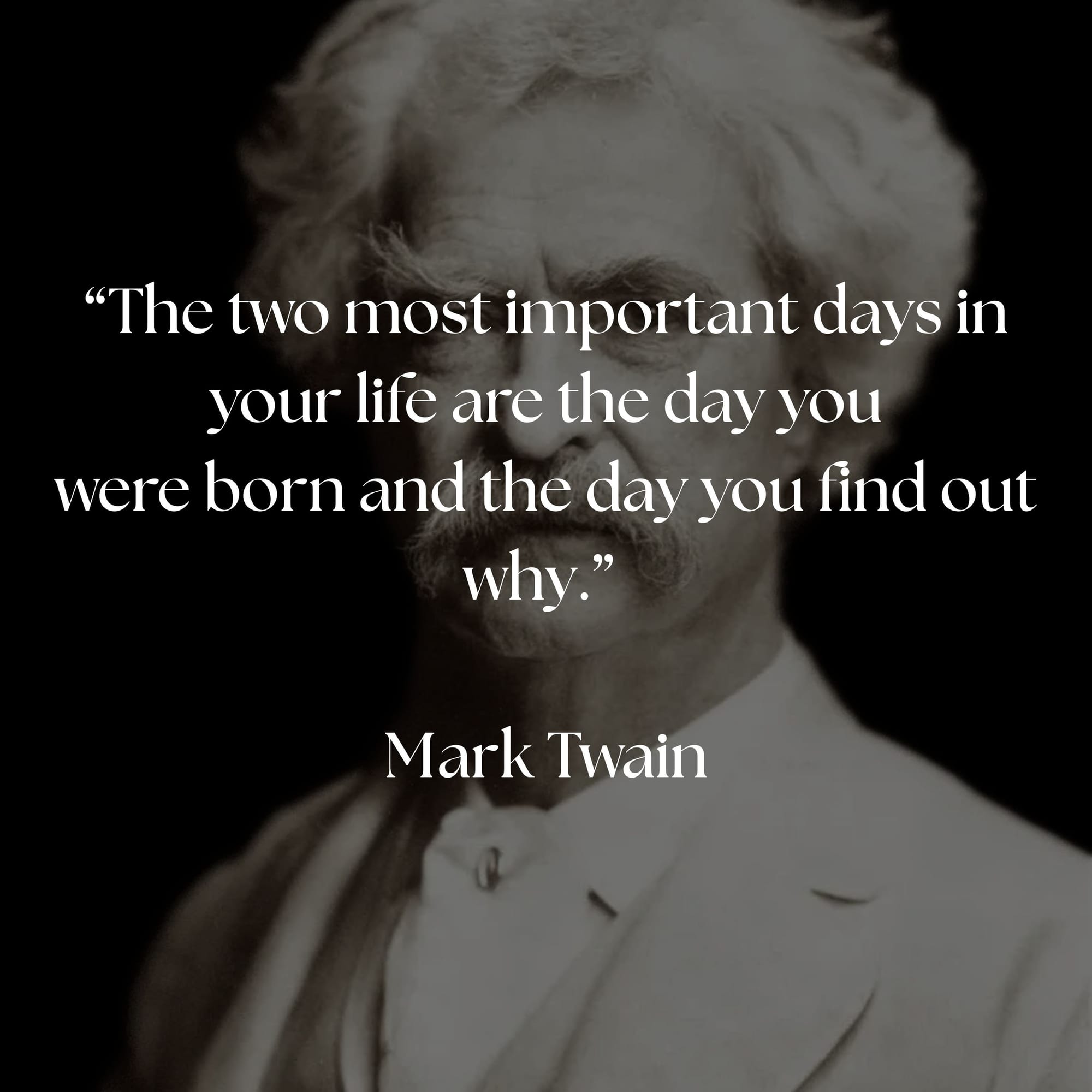
Believing in yourself isn't an act of will; it’s an act of discovery. It’s about finding your unique neurological wiring and the activities that leave you with more energy than when you started—and having the courage to weave them into the fabric of your life. It costs nothing to look for them, but as I found out, it costs everything to ignore them.
If you're interested, let me know, and I can help guide you through these exercises to help you find out who "yourself" really is.
References to the study about burnout and time spent:
