
"It's Not Silly"
Henry thinks it's silly.
He's sitting across from his wife Dawn in a counselor's office, and Dawn is upset — genuinely, tearfully upset — because Henry doesn't give her gifts. Birthdays. Christmas. Whatever. No gifts. And Henry is doing what I would have done, what most of us would have done: he's defending himself. Internally dismissing it. A gift thing. Seriously???
The counselor is Julie Schwartz Gottman — one of the foremost couples researchers in the world. She's watched this exact dynamic about ten thousand times. She knows what's happening. And she introduces a deceptively simple exercise: She hands Henry a slip of paper with 4 questions on it:
- Tell me why this is so important to you.
- Is there a story behind this for you?
- What do you wish for?
- Is there a deeper purpose or goal in this for you?
She tells Henry to ask Dawn one of the questions, and to then shut up and listen.
Henry asks: "Is there a story behind this for you?"
There's a forty-second pause.
Forty seconds of silence in a therapy room is an eternity. You can feel it.
Dawn's eyes fill with tears. And then it comes out. She was raised by her grandmother. There were no Christmases. No birthdays. No socks. No gifts. Not one. As a kid, she would page through catalogues and circle things she would like to get as a gift, hoping, dreaming. She'd look at the pictures like they were from another world.
"It seems silly," she says.
Schwartz doesn't skip a beat: "It's not silly."
Henry leans in and asks: "What would it mean — if gifts were given to you?"
Dawn: "It's a visual representation of your love for me. If you picked up a rock on the way home and said, 'I saw this rock, it was shiny and small and made me think of you' — I would keep that rock forever."
Something happens in the room. You can see it. Henry's gaze warms. Dawn's posture softens. The wall between them drops about six feet in thirty seconds.
That's the power of one genuine question. One moment of actually giving a shit.
Dan Coyle, in his remarkable book Flourish, calls what just happened an "awakening cue." I'll come back to exactly what that means. But first — I have a confession to make, and the memory of it still stings after so many years.
I've been Henry in the past, and he still tries to surface from the depths of my earlier programming. I would also have thought that Dawn's issue with gifts was "silly." I just would not have been able to relate to it. My brain would have said: big deal. Get over it.
In other words, I would have judged.
And judging never leads to understanding. It only leads to separation.
Now imagine — or maybe you're living it right now — the slow, pernicious downward spiral that can happen over time when a "silly issue" like this gets brushed off with dismissiveness or outright judgment. It may seem like no big deal in the moment. But each little skirmish, each failure to actually hear the other person, leads to an accretive pile of relationship dung that eventually stinks up the whole farm. And others can smell it. Your kids can smell it. Your colleagues can smell it.
The pile builds one scoop at a time.
But I'm not just talking about couples in a therapist's office.
An example:
My daughter Rachel was a college sophomore trying to figure out her major. She wanted to talk it through with me, so she came to my office at the University.
She told me recently that she was sick to her stomach all the way over to my office. Even more painful to admit? I have zero recollection of our meeting.
Think about that. She already knew — before she opened her mouth — what the temperature in the room was going to be. When she told me she was considering a communications major, I poked holes in it. I suspect I asked a few questions that were almost certainly alienating. I made it clear, without ever quite saying it, that I wasn't approving.
Her "silly issue" — what do I want to do with my life? who am I? — got treated like a problem to be solved rather than a mystery worth exploring. I was running on spotlight mode. She needed a lantern.
She left my office having learned something. Not about her major. Not about her future. Not about what interested her. She learned it was not safe to bring things to Version I Michael Maddaus.
Another example:
A client of mine said something recently that I haven't been able to shake. We were talking about conflict — why he struggles with it, why it feels so dangerous to him. He said: "We didn't do conflict in our house growing up."
Nine words. That's all. But buried in those nine words are a whole story — a whole neural architecture, built in childhood, still running in the background today. When conflict arises in his adult life, his nervous system doesn't reach for curiosity. It reaches for the exit. Not because he's weak, not because he's avoidant by choice — but because his brain learned, early and effectively, that conflict meant something bad was coming.
That's his "silly issue." And it's anything but silly.
My own "silly issue"? Betrayal.
My mother was an alcoholic and suicidal. When I was a kid, she would drink, end up bedridden and starving, go to the hospital, dry out, come home — and suddenly normal mom was back. I was overjoyed. I was inappropriately optimistic every single time. This will be the last relapse. This time it's over. It never was. The day always came when she took the first drink again.
So the software running in the dark, silent vault of my skull developed a file called Betrayal. And that file got updated with each relapse, each fresh betrayal of my hope. My brain was doing its job — it was learning the pattern, cataloguing the threat, trying to protect me.
The problem is: that software doesn't stop running when childhood ends.
As an adult, the Betrayal file would get called up — sometimes way out of proportion to whatever was actually happening. Someone close to me would cancel plans, or not show up, or disappoint me in some ordinary human way, and my internal reaction would be... outsized. Not in proportion to what had happened today. In proportion to what had happened thirty years ago.
The moment that made it undeniable? My daughter Maya bailing on a lunch date.
Maya bailing on lunch is not a trauma. It's not even close. But my reaction — the tightening, the withdrawal, the heat of it — was way too large for the stimulus. It was then that I finally saw it. The old adaptive childhood program, still alive and well, still running in my mental hard drive. Still misidentifying the threat.
Until I woke up to these psychological realities, my working assumption was: when my mother died, it was done. Over. No further impact on my life. I trivialized my own "silly Mommy issue" because I didn't know any better.
It took Hazelden to crack me open. And even then, it didn't happen all at once.
Here's the thing about "silly issues" — and this is the insight that Coyle's book drove home for me so hard I had to put it down and stare at the ceiling for a minute.
We resist understanding them. We resist validating them. And here's why: we secretly believe that if we focus on someone's "silly issue" — if we lean into it, ask about it, we think we will fan the flames into a roaring fire — we're going to make it worse. We'll reinforce it. Magnify it. Make it more entrenched, more powerful, less likely to ever go away. Then we have to listen to it all again, and again, and again......
It is exactly the opposite.
Understanding and validation don't reinforce the wound. They begin to heal it. The moment someone's "silly issue" is actually seen — when another person leans in and says "that's not silly," when they ask a real question and sit in the silence waiting for the real answer — something loosens. The grip relaxes. And what felt immovable starts to shift.
John and Julie Gottman know this better than almost anyone. So it's interesting — and humanizing — that they had to learn it themselves.
John Gottman is a world-class research psychologist, born and raised in Manhattan. Nature, for John, was "what you brushed off your clothes after a picnic in Central Park." (His words.) His Jewish ancestors fled Vienna with nothing, and the family belief — baked in over generations — was: don't invest in property. It can be confiscated. Don't get attached.
Julie Schwartz Gottman grew up in a chaotic, dysfunctional home. Her escape was the old-growth forest near where she lived. She would sneak out at night, alone, into those trees — and that's where she felt safe. That forest was her safe place.
So when Julie wanted a cabin on Orcas Island, John resisted. Hard. They argued. They went to a therapist, who told John to set "firm boundaries" — just say no. They fired the therapist.
Then Julie asked a different question. Not "why won't you do this for me?" But: "What was that about? Like deep down — what was that about?"
And out came the family story. The ancestors. Vienna. The confiscation. Don't invest. Don't attach.
And John finally understood Julie's story — the forest, the safety, the sanctuary of those trees. What it meant. Not as a real estate decision, but as something much older and deeper.
In the past, I likely would have trivialized both of these. Julie's "silly" thing about the forest as a safe place — I would have said, internally, get over it. John's ancestral fear about property — same. Come on. That's ancient history. Move on.
We all carry baggage from the events in our lives. The question is whether we know we're carrying it.
So what is actually happening in these moments — when Henry leans in, when Julie asks the deeper question, when the room shifts?
Coyle, drawing on the neuroscientist Iain McGilchrist, describes two fundamentally different modes of paying attention.
The first is what I'd call the spotlight mode. Narrow, focused, controlling. It categorizes, predicts, and moves on. It wants to solve and conquer. It says: I already know what this is. It fragments the world into manageable pieces. In evolutionary terms, this is the attention you needed to identify the food or the predator right in front of you.
The second is what I'd call the lantern mode. Wide, open, receptive. It doesn't know in advance what it's looking for. It picks up subtle patterns, context, the emotional undercurrent of a room, the thing that's just slightly off. In evolutionary terms, this is the attention you needed to sense the broader environment — the sudden silence of birds in the forest that might mean a predator was close.
Both of these systems are necessary. As Coyle writes, if you only focus narrowly, you'll miss the bigger patterns that keep you connected and alive. If you only gaze widely, you'll starve.
McGilchrist puts it this way: "When you attend narrowly, you will see the world as a flat puzzle, as a representation, as something inanimate to be manipulated. But when you stop and cultivate an active receptivity to something that is not yourself, you allow yourself to sense and respond to it — and it comes into being."
And here is a line from the book that I think is worth never forgetting: "The type of attention we bring to the world changes the world we find."
The Buddhist tradition has its own language for this. The monkey mind — quick, grabby, easily snagged by cravings and certainties, always wanting to resolve the ambiguity and move on. Then there's the forest-deer mind — open, unhurried, attuned to what's actually unfolding.
Henry, in that therapist's office, shifted from monkey mind to forest-deer mind in one sentence: "Is there a story behind this for you?"
He stopped needing to be right. He stopped trying to solve it. He asked a question and actually listened. He was able to really see and hear Dawn. He just... lit the lantern.
And the whole room changed.
Schwartz described what she watched happen: "When they first tried to deal with the conflict, they're very centered in themselves... You're seeing your partner in a two-dimensional way, like they are a paper doll. But when you ask those questions, and then you sit quietly to really listen to the responses — that light shines and opens things up."
Gottman called it something even more beautiful: "It's like music. The music is coming through them from somewhere else."
When I think about my perspective now compared to before Hazelden — before the thing that cracked me open — it boils down to finally getting this fact: we are all a product of a myriad of environmental forces that shaped and molded us over time. All of those forces, injected into 85 billion brain cells over decades of living, have a profound influence on how we see each other and react to the world.
That's not a cop-out. It's not an excuse for staying stuck.
It's actually the beginning of freedom. Because once I understood that about myself — the Betrayal file, the software, the way old programming runs without your knowledge or consent — I could finally start to update it. Slowly. Imperfectly. With help. And I started seeing other humans in a very different light. The light from a lantern and not a spotlight.
Here's what strikes me now about modern life: we have never been less equipped to do this.
When I was in surgery residency — which was before computers, before email, before Slack, before iPhones — we had green plastic charts and handwritten notes like: "Doing well." "No problems overnight. Discharge tomorrow." We had a doctor's dining room where people actually sat down together for lunch. We had OR break rooms where nurses and doctors hung out (many of them smoking cigarettes) and had spontaneous conversations. You'd learn things. About each other. About your patients. About what was actually going on.
Now? Spotlight mode all day long. Rounds on computers. Faces buried in iPhones. The small moments — the gaps between tasks where connection actually happens are stolen by a firehose of information and dopamine triggers and a weary, overstimulated brain that just wants to be alone.
The type of attention we bring to the world changes the world we find.
When I texted Rachel to ask if she had a story about Version I Michael Maddaus I could use for this piece, she gave me the college major one. Then we texted this:
Michael: God I LOVE YOU and thank you SO MUCH for sharing that - it is hard to hear but it is the truth and when I say I am sorry I mean it and I know you're not looking for that - but I really am - and it is because of your and your siblings honestly that I could finally see how I impacted you all. I wish I knew then what I know now...
Rachel: I didn't share for an apology. You're far different. Anyway, you were wrong 🤪 I love you.
Me: I know you didn't share it for an apology, but nevertheless, I owe you one. And I love you too, sweetheart.
Rachel: I'm happy we are as close as we are 💕.
That exchange — right there — is an awakening cue. I asked a real question. She answered honestly. I kept my armor down. Not easy!! And something that had been sitting between us for twenty-some years got a little lighter.
It doesn't require a therapist's couch. It doesn't require a forty-second pause in a session room. It just requires one genuine question — and the willingness to really hear the answer.
It's not silly.
It never was.
If you want a practical guide to actually doing this — how to listen at the level that creates these moments, how to watch your tone, what never to say — I've put together a short field guide you can download below.
Henry thinks it's silly.
He's sitting across from his wife Dawn in a marriage counselor's office, and Dawn is upset — genuinely, tearfully upset — because Henry doesn't give her gifts. Birthdays. Christmas. Whatever. No gifts. And Henry is doing what I would have done, what most of us would have done: he's defending himself. Internally dismissing it. A gift issue? Seriously?
The counselor is Julie Schwartz Gottman — one of the foremost couples researchers in the world. She's watched this exact dynamic about ten thousand times. She knows what's happening. And she introduces a deceptively simple exercise: She hands Henry a slip of paper with 4 questions on it:
- Tell me why this is so important to you.
- Is there a story behind this for you?
- What do you wish for?
- Is there a deeper purpose or goal in this for you?
She tells Henry to ask Dawn one of the questions, and to then shut up and listen.
Henry asks: "Is there a story behind this for you?"
There's a forty-second pause.
Forty seconds of silence in a therapy room is an eternity. You can feel it.
Dawn's eyes fill with tears. And then it pours out like a burst pipe. She was raised by her grandmother. There were no Christmases. No birthdays. No socks. No gifts. Not one. As a kid, she would circle things in catalogs — just hoping. Just dreaming. She'd look at the pictures like they were from another world.
"It seems silly," she says.
Schwartz doesn't skip a beat: "It's not silly."
Henry leans in. He asks: "What would it mean — if gifts were given to you?"
Dawn says: "It's a visual representation of your love for me. If you picked up a rock on the way home and said, 'I saw this rock, it was shiny and small and made me think of you' — I would keep that rock forever."
Something happens in the room. You can see it. Henry's gaze warms. Dawn's posture softens. The wall between them drops about six feet in thirty seconds.
That's the power of one genuine question. One moment of actually giving a shit.
Dan Coyle, in his remarkable book Flourish, calls what just happened an "awakening cue." I'll come back to exactly what that means. But first — I have a confession to make, and it stings.
I have been like Henry.
I am still like Henry sometimes, though I hope less than in the past.
I could immediately imagine being in Henry's shoes and being dismissive — either openly or quietly, in that covert way we do when we've already made up our mind — of Dawn's "silly" issue with gifts. I just would not have been able to relate to it. My brain would have said: big deal. Get over it.
In other words, I would have judged.
And judging never leads to understanding. It only leads to separation.
Now imagine — or maybe you're living it right now — the slow, pernicious downward spiral that can happen over time when a "silly issue" like this gets brushed off with dismissiveness or outright judgment. It may seem like no big deal in the moment. But each little skirmish, each failure to actually hear the other person, leads to an accretive pile of relationship dung that eventually stinks up the whole farm. And others can smell it. Your kids can smell it. Your colleagues can smell it.
The pile builds one shovelful at a time.
But I'm not just talking about couples in a therapist's office. I'm talking about my own kitchen table.
My daughter Rachel was a college sophomore trying to figure out her major. She wanted to talk it through with her dad. She came to my office at the University.
She told me recently that she was sick to her stomach before she walked in the door.
Think about that. She already knew — before she opened her mouth — what the temperature in the room was going to be. When she told me she was considering a communications major, I poked holes in it. Asked a lot of questions. Made it clear, without ever quite saying it, that I wasn't approving.
Her "silly issue" — what do I want to do with my life? who am I? — got treated like a problem to be solved rather than a mystery worth exploring. I was running on spotlight mode. She needed lantern.
She left my office having learned something. Not about her major. About what was safe to bring to her father.
Version 1 Michael Maddaus. Better. Still a work in progress.
A client of mine said something recently that I haven't been able to shake. We were talking about conflict — why he struggles with it, why it feels so dangerous to him. He said: "We didn't do conflict in our house growing up."
Six words. That's all. But those six words are a whole story — a whole neural architecture, built in childhood, still running in the background today. When conflict arises in his adult life, his nervous system doesn't reach for curiosity. It reaches for the exit. Not because he's weak, not because he's avoidant by choice — but because his brain learned, early and effectively, that conflict meant something bad was coming.
That's his "silly issue." And it's anything but silly.
My own "silly issue"? Betrayal.
My mother was an alcoholic and suicidal. When I was a kid, she would drink, end up bedridden and starving, go to the hospital, dry out, come home — and suddenly normal mom was back. I was overjoyed. I was inappropriately optimistic every single time. This will be the last relapse. This time it's over. It never was. The day always came when she took the first drink again.
So the software running in the dark, silent vault of my skull developed a file called Betrayal. And that file got updated with each relapse, each fresh betrayal of my hope. My brain was doing its job — it was learning the pattern, cataloguing the threat, trying to protect me.
The problem is: that software doesn't stop running when childhood ends.
As an adult, the Betrayal file would get called up — sometimes way out of proportion to whatever was actually happening. Someone close to me would cancel plans, or not show up, or disappoint me in some ordinary human way, and my reaction would be... outsized. Not in proportion to what had happened today. In proportion to what had happened thirty years ago.
The moment that made it undeniable? My daughter Maya bailing on a lunch date.
Now, Maya bailing on lunch is not a trauma. It's not even close. But my reaction — the tightening, the withdrawal, the heat of it — was way too large for the stimulus. And I finally saw it. The old adaptive childhood program, still alive and well, still running in my mental hard drive. Still misidentifying the threat.
Until I woke up to these psychological realities, my working assumption was: when my mother died, it was done. Over. No further impact on my life. I trivialized my own “Silly Mommy issue" because I didn't know any better. Because in surgery culture in the 1980s and 90s, you just didn't go there. That shit was for other people.
It took Hazelden to crack me open. And even then, it didn't happen all at once.
Here's the thing about "silly issues" — and this is the insight that Coyle's book drove home for me so hard I had to put it down and stare at the ceiling for a minute.
We resist understanding them. We resist validating them. And here's why: we secretly believe that if we focus on someone's "silly issue" — if we lean into it, ask about it, fan the flames — we're going to make it worse. We'll reinforce it. Magnify it. Make it more entrenched, more powerful, less likely to ever go away.
It is exactly the opposite.
Understanding and validation don't reinforce the wound. They begin to heal it. The moment someone's "silly issue" is actually seen — when another person leans in and says "that's not silly," when they ask a real question and sit in the silence waiting for the real answer — something loosens. The grip relaxes. And what felt immovable starts to shift.
John and Julie Gottman know this better than almost anyone. So it's interesting — and humanizing — that they had to learn it themselves.
John Gottman is a world-class research psychologist, born and raised in Manhattan. Nature, for John, was "what you brushed off your clothes after a picnic in Central Park." (His words.) His Jewish ancestors fled Vienna with nothing, and the family belief — baked in over generations — was: don't invest in property. It can be confiscated. Don't get attached.
Julie Schwartz Gottman grew up in a chaotic, dysfunctional home. Her escape was the old-growth forest near where she lived. She would sneak out at night, alone, into those trees — and that's where she felt safe. That forest was her safe place.
So when Julie wanted a cabin on Orcas Island, John resisted. Hard. They argued. They went to a therapist, who told John to set "firm boundaries" — just say no. They fired the therapist.
Then Julie asked a different question. Not "why won't you do this for me?" But: "What was that about? Like deep down — what was that about?"
And out came the family story. The ancestors. Vienna. The confiscation. Don't invest. Don't attach.
And John finally understood Julie's story — the forest, the safety, the sanctuary of those trees. What it meant. Not as a real estate decision, but as something much older and deeper.
In the past, I likely would have trivialized both of these. Julie's "silly" thing about the forest as a safe place — I would have said, internally, get over it. John's ancestral fear about property — same. Come on. That's ancient history. Move on.
We all carry baggage to every event in our lives. The question is whether we know we're carrying it.
So what is actually happening in these moments — when Henry leans in, when Julie asks the deeper question, when the room shifts?
Coyle, drawing on the neuroscientist Iain McGilchrist, describes two fundamentally different modes of paying attention.
The first is what I'd call the spotlight mode. Narrow, focused, controlling. It categorizes, predicts, and moves on. It wants to solve and conquer. It says: I already know what this is. It fragments the world into manageable pieces. In evolutionary terms, this is the attention you needed to identify the food or the predator right in front of you.
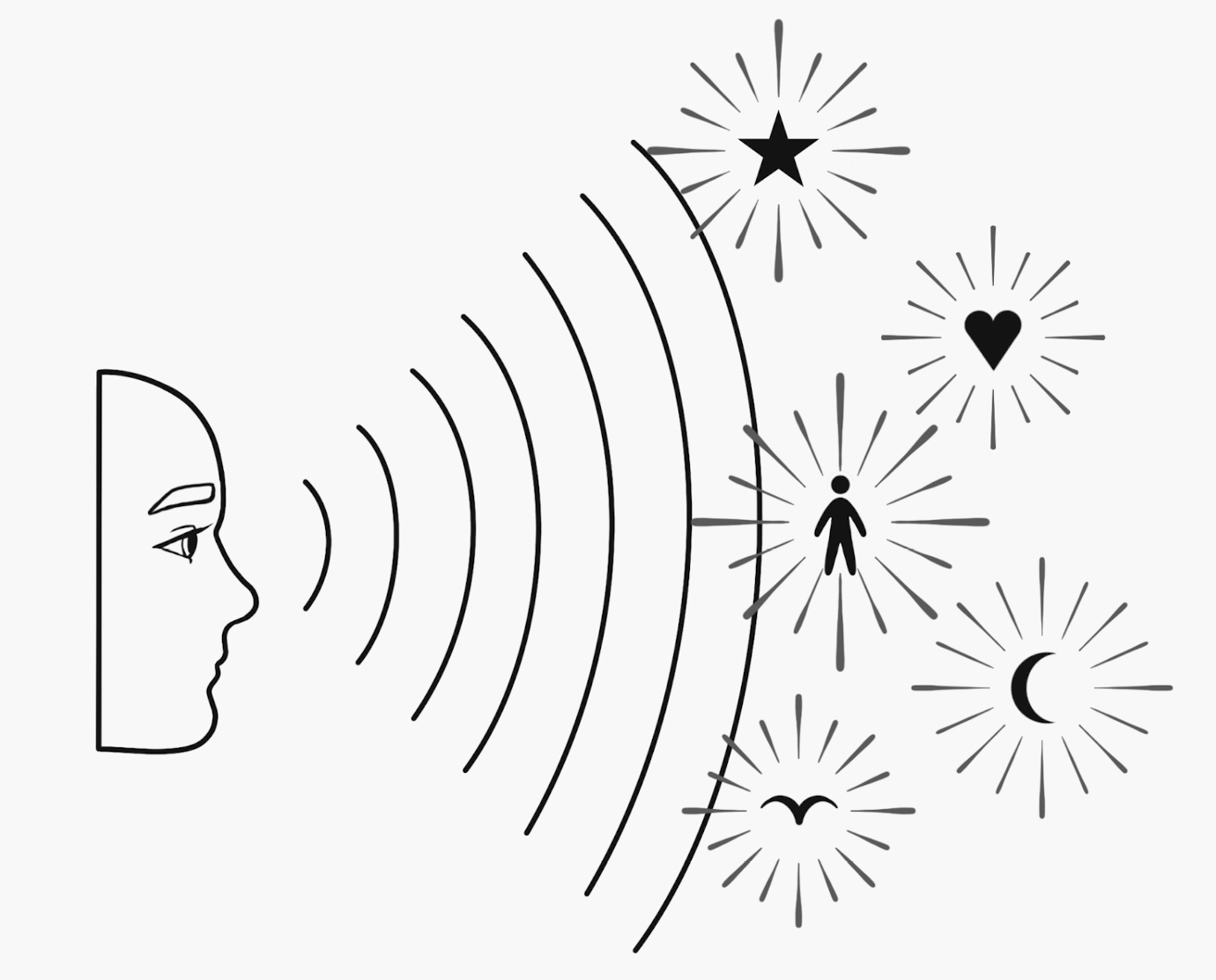
The second is what I'd call the lantern mode. Wide, open, receptive. It doesn't know in advance what it's looking for. It picks up subtle patterns, context, the emotional undercurrent of a room, the thing that's just slightly off. In evolutionary terms, this is the attention you needed to sense the broader environment — the sudden silence of birds in the forest that might mean a predator was close.
Both of these systems are necessary. As Coyle writes, if you only focus narrowly, you'll miss the bigger patterns that keep you connected and alive. If you only gaze widely, you'll starve.
McGilchrist puts it this way: "When you attend narrowly, you will see the world as a flat puzzle, as a representation, as something inanimate to be manipulated. But when you stop and cultivate an active receptivity to something that is not yourself, you allow yourself to sense and respond to it — and it comes into being."
And then this line, which stopped me cold: "The type of attention we bring to the world changes the world we find."
The Buddhist tradition has its own language for this. The monkey mind — quick, grabby, easily snagged by cravings and certainties, always wanting to resolve the ambiguity and move on. Versus the forest-deer mind — open, unhurried, attuned to what's actually unfolding.
Henry, in that therapist's office, shifted from monkey mind to forest-deer mind in one sentence: "Is there a story behind this for you?"
He stopped needing to be right. He stopped trying to solve it. He just... opened the lantern.
And the whole room changed.
Schwartz described what she watched happen: "When they first tried to deal with the conflict, they're very centered in themselves... You're seeing your partner in a two-dimensional way, like they are a paper doll. But when you ask those questions, and then you sit quietly to really listen to the responses — that opens things up."
Gottman called it something even more beautiful: "It's like music. The music is coming through them from somewhere else."
When I think about my perspective now compared to before Hazelden — before the thing that cracked me open — it boils down to finally getting this fact: we are all a product of a myriad of environmental forces that shaped and molded us over time. All of those forces, injected into 85 billion brain cells over decades of living, have a profound influence on how we see each other and react to the world.
That's not a cop-out. It's not an excuse for staying stuck.
It's actually the beginning of freedom. Because once I understood that about myself — the Betrayal file, the software, the way old programming runs without your knowledge or consent — I could finally start to update it. Slowly. Imperfectly. With help.
And once I understood it about other people — about Dawn and her catalog circles, about my client who learned that conflict meant danger, about John Gottman and his family's Vienna fear — I stopped dismissing people. I started getting curious.
Here's what strikes me now about modern life: we have never been less equipped to do this.
When I was in surgery residency — which was before computers, before email, before Slack, before iPhones — we had green plastic charts and handwritten notes like "Doing well." "No problems overnight. Discharge tomorrow." We had a doctor's dining room where people actually sat down together for lunch. We had OR break rooms where nurses and doctors hung out (many of them smoking cigarettes, which — different era, not recommending it) and had spontaneous conversations. You'd learn things. About each other. About your patients. About what was actually going on.
Now? Rounds on computers. Faces on phones. The small moments — the gaps between tasks where connection actually happens — stolen by a firehose of information and dopamine triggers and a weary, overstimulated brain that just wants to be alone.
My daughter Anne is a nanny for a busy family with two kids. She tells me they rarely eat dinner together. Everyone forages independently. There's a constant hum of traffic — notifications, devices, the pull of the screen.
In our house, when all six kids were growing up, dinner together was close to non-negotiable. Lea would wait — even coming off a night call as a high-risk OB — until we could all sit at our round pine table, faces in line, food on the table. Sports and school and work and mayhem and all the rest of it, and still: dinner. Together. Almost every night.
I always knew it mattered. I didn't really know why — not in the way that I can explain it now — until I read Flourish.
The dinner table is an awakening cue. It's structured lantern time. It's the moment in the day when the spotlight turns off, the foraging stops, and you actually sit in the presence of the people you love. You see their faces. You hear their voices. You notice that something is slightly off with one of the kids, and you ask — not because you had it scheduled, but because you were paying the kind of attention that only happens when you slow the hell down.
The type of attention we bring to the world changes the world we find.
So here's the question I'd ask you to sit with this week.
What's your "silly issue"? Not someone else's — yours. The reaction that's a little too hot. The topic you always avoid. The thing that got dismissed so many times you stopped bringing it up, and started pretending it wasn't there.
And equally: whose "silly issue" have you been brushing off? A partner, a kid, a colleague, a direct report? Someone whose Dawn-in-the-catalog story you've never actually asked about?
The path to understanding isn't through debate and dismissal. It's through one genuine question — and then the discipline to shut up and actually listen to the answer.
It's not silly.
It never was.
Dr. Michael Maddaus is a retired cardiothoracic surgeon, executive coach, and author of The Resilient Surgeon newsletter. He works with surgeons and senior leaders on performance, resilience, and what it means to lead a fully-lived life. If this resonated, he'd love to hear from you.
Word count: ~2,300
I am reading an eye opening book by Dan Coyle called Flourish that is about-surprise-human flourishing. Chapter 5, "Music Lessons: A Love Story," is about John Gottman and Julie Schwartz, the two famous relationship psychologists, and it includes a story about Dawn and Henry, a couple who had a counseling session with Julie Schwartz. The session had been previously videotaped and Coyle watched the tape with Gottman and Schwartz. Here is the story of the session in Coyle's words copy and pasted verbatim:
Dawn and Henry’s history has been filled with challenges: They married young and have gone through infidelity, life-threatening injury, and all manner of turbulence. In this session, they are focusing on a persistent conflict regarding gift giving and receiving. Dawn feels that Henry doesn’t show his love enough via gifts. Henry is hurt by this; he feels like he gives plenty of gifts, plus he shows his love in many other ways.
Onscreen, Henry and Dawn sit on a soft leather couch a few feet apart. Henry holds a pillow at his midsection; Dawn is partly covered by a blanket. Schwartz sits facing them, her corgi lounging at her feet.
The session starts roughly. Schwartz introduces the topic of gifts and asks each to describe their feelings. They are touchy, each defending past behaviors, making logic-based arguments and rebuttals—their controlling attention systems are definitely in charge.
After about ten minutes, Schwartz introduces the exercise: One partner will be the speaker, the other the listener, each taking a turn in each role. First, the speaker will talk about what gifts mean to them; then the listener will ask open-ended questions. The only rule: The question-asker must listen to the answer—no persuading, no trying to solve it, armor down. Schwartz hands Henry a piece of paper on which are written a few prompts. Among them:
Tell me why this is so important to you.
Is there a story behind this for you?
What do you wish for?
Is there a deeper purpose or goal in this for you?
Schwartz asks Dawn to speak about what gifts mean to her. Dawn begins by telling about her childhood being raised by her grandmother.
“I don’t remember growing up with a lot of gifts,” she says. “I remember sharing a lot. There wasn’t anything that was particularly mine. I always had the dream of being given to at some point. Maybe if I give enough, someone will give to me.”
Schwartz prompts Henry to pick a question from the paper.
“Is there a story behind this for you?” Henry asks.
A full forty-second pause. Henry waits. Dawn’s eyes fill; her voice is halting and muffled with tears.
“I wasn’t given much. I was told I needed to be appreciative because people were taking care of me. They’d buy stuff for their kids. I wouldn’t even get a bag of socks. No Christmases, no birthdays. I felt like, if I give enough to somebody, they’ll give something back. But it didn’t seem like anybody does.”
“Did that ever work for you when you were a kid?” Henry asks.
“I’d wrap up all my stuff and give it to everybody,” Dawn says. “Clothes, anything I could find, when it was time for a gift. If it was birthday or Christmas, my whole neighborhood would be walking around in my clothes…. That’s the way I was raised. I remember going through these books and circling toys, every year they’d come in the mail.”
Schwartz’s voice is soft. “What would come in the mail?”
“Catalogs,” Dawn says. “I’d circle anything, hopefully, even if I didn’t want it…. It seems silly.”
“It’s not silly,” Schwartz murmurs. Henry asks, “What would it mean if gifts were given to you?”
Dawn’s tears rise. “It’s a visual representation of your love for me. Something that I can see, hold. Or wear. If you picked up a rock on the way home and said I saw this rock, it was shiny and small and made me think of you, I would keep that rock forever.”
At this point, something shifts: a warming of Henry’s gaze, a softening in Dawn’s posture. They continue talking, but the defensiveness has evaporated, replaced by warmth, curiosity, empathy. What was an argument has become, through exploring a few deep questions, a meaningful connection. On a purely logical level, this shift makes no sense. Schwartz has offered no insights, no advice. Henry has asked two questions—Is there a story behind this for you? and What would it mean if gifts were given to you?—and then sat in silence. Dawn has shared a few sentences, a couple memories; most of the session has been one long pause. But that’s how awakening cues work.
Here’s how Schwartz describes the shift: “When they first tried to deal with the conflict, they’re very centered in themselves,” she says. “And like every human being, we want control. Control for our world. And if our world includes the partner, we want to control some aspect of our partner’s behavior. So at first you’re seeing your partner in a two-dimensional way, like they are a paper doll or a marionette, and so you end up repeating yourself over and over again, to try and get them to see it your way. But when you ask those questions, and then you sit quietly to really listen to the responses—that opens things up.”
We rewound the video again to the middle of the interaction, right when Dawn is sharing the story of her childhood.
“Before this, Henry’s face had been hard, it had been a little sarcastic, a little cutting or critical,” Schwartz says. “And now it was none of that. He’s feeling it with ease, feeling it with her. He now sees his partner as a flesh-and-blood, three-dimensional being, with her own world of experience—a history of pain, of suffering, of love, of lack of love, of the whole spectrum of human emotion. And there is this profound shift of awareness, this huge expansion, where you see them fully, and you feel them fully.”
We rewound and watched the moment again: the softening of eyes and opening of body language.
“It’s like music,” Gottman says. “Like when you see someone play the violin, they are playing, but the music is coming through them from somewhere else. It’s a whole different way of connecting. I think that’s what happens to those couples, and to Julie, in that moment.”
I have a confession to make, and it stings. I have been like Henry. I am still like Henry sometimes, though I hope less than in the past. I could immediately imagine being in his shoes and being dismissive (either overtly or covertly) of Dawn's "silly" issue with gifts. I just would not have been able to relate to her issue, and I would have thought "big deal, just get over it."
In other words, I would have been judgmental about the gift issue. And judging never leads to understanding. Only separation.
Imagine (or perhaps you are living it now) the pernicious slow downward spiral in the relationship that can occur over time when a "silly issue" like the gift giving is brushed off with dismissiveness or outright judgment. It may seem like no big deal in the moment, but each little skirmish and lack of understanding leads to an accretive pile of relationship dung that stinks up the whole relationship farm. Plus the smell can be smelled by others in the vicinity.
But the same thing can occur with yourself. It happened to me.
My mother was an alcoholic and suicidal. As a kid she would drink, end up bedridden and starving, go to the hospital, dry out, come home, normal "mom" was back, I am overjoyed and inappropriately optimistic that this will be the last relapse, but it never was. The day always came when she took the first drink again.
The "silly issue" installed in my brain? Betrayal. Then as an adult, the Betrayal file would get called up from the past when someone close (family) personally disappointed me. Result? Out of proportion reaction to the current stimulus. It wasn't until I got so triggered by my daughter Maya bailing out of a lunch date that I realized how my old adaptive childhood software program was still alive and well in my mental hard drive.
Until I finally "woke" up to these psychological realities, I was of the mindset that when my mother died, it was all over. Done and gone. No further impact on my life. I trivialized my "silly" Mommy issue because I didn't know any better.
The point is that not only did I not know any better, but neither did Henry or Dawn or the overwhelming majority of us. We all routinely fail at understanding the CONTEXT of a person's "silly" issue, like Dawn's silly "gift" issue, or my silly "Mommy" issue.
Another story from the chapter, but this one is about the John Gottman and Julie Schwartz who worked with Henry and Dawn:
John Gottman and Julie Schwartz met on a blind date. John was a University of Seattle psychologist who loved data and measuring things. He had an apartment converted into a relationship laboratory with cameras and heart rate sensors. Julie on the other hand was a street smart clinician (psychologist) who had spent years working in Boston in some of the most underserved communities. John = data, equations, intellectual certainty. Julie = trusted her gut but less sure of herself intellectually.
There were other differences. John was afraid of going into a forest or climbing a mountain. Julie loved the outdoors and was supremely confident in the outdoors and with complex emotions.
Not long after they were married Julie suggested they buy a cabin on Orcas Island near Seattle. John resisted big time and they argued about it so much that they went to a therapist.
They were told they need firm boundaries. The therapist told them: "You have to be able to say no, and your partner has to accept that they’re different from you, to respect those boundaries."
“The therapist was all about boundaries!” Gottman says. “She turned to me during one session and told me, ‘Just say no to her. Julie has to learn to live with it.’ She wanted me to act like a dog trainer!”
They fired the therapist. Instead, Julie began to wonder why John was so resistant to the cabin idea and asked "What was that about? Like deep down, what was that about?"
Turns out John grew up in Manhattan and nature to John was what you brushed off your clothes after a picnic in Central Park. Digging deeper, Julie discovered that John's ancestors were Jews who left Vienna with nothing in their pockets after having their property and belongings taken. John was then raised to believe that you do not invest in property, especially a cabin in the woods, because it could be confiscated at any time.
Julie, on the other hand, grew up in a "very crappy, very dysfunctional" home, so at night she would sneak out to an old-growth forest two blocks away and spend time alone there in the trees. It was her "safe" place.
Disclaimer: In the past, I likely would have trivialized the importance of Julie's "silly" issue of the forest being a safe place. Same with John. As in "Get Over It." (And yes there is an absolute time and place for Get Over It, but not with this stuff).
We all have baggage that we bring to every event in our lives, and some of the luggage I would have brought to the judgment train would have been the "no big deal" bag from my unusually tumultuous past, and the fear of escalating the intensity of the issue should I feed the flames with understanding, thereby magnifying the issue.
Here is the thing. We so often confuse genuine understanding and validation of another person's experience (especially their "silly issues") because we fear that by focusing on it and fanning the flames of their emotions the "silly issue" will become even more powerful and less likely to go away.
It is just the opposite. Having another person actually understand, validate, and not judge our "silly issues" takes their power away from the person with the "silly issue." They can breathe a lot easier because another person held them in a container of caring and love, without an agenda of their own.
But there is something even more profound and interesting than all of that: awakening cues.
Turns out we have two very different attention systems in the brain, one for narrow control and one for deep connection. The narrow control system is called the Controlling Attention System, and it is located in the left hemisphere and its job is to work like a spotlight that focuses on a target. It sees the world as a bunch of fragments or pieces of a puzzle to be assembled so it can predict, conquer, and move on, and it craves certainty.
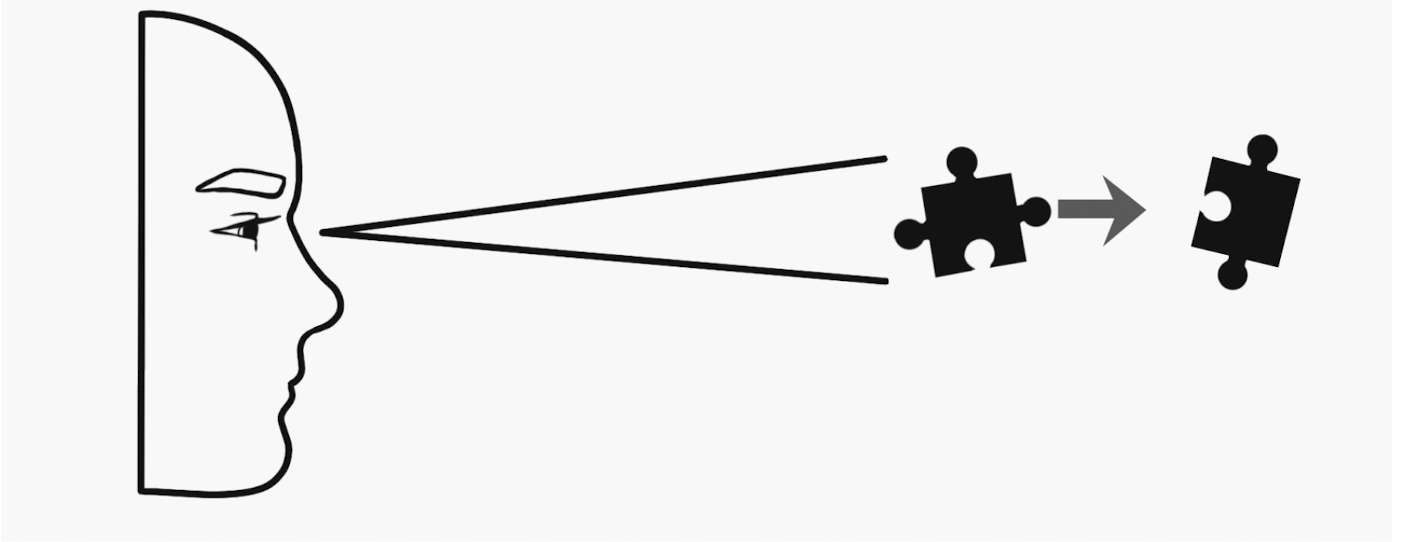
Your Connective Attention System hangs out in the right hemisphere and rather than being a spotlight, it works like a lantern that reveals a wide, layered, three dimensional whole. Certainty is not the game here, rather it thrives on ambiguity, attunes to context, and picks up on subtle patterns. Unlike the Controlling Attention System which is about conquering its surroundings, the Connection Attention System is about allowing you to sense something larger - relationships, dynamics, and other forces beyond yourself and to feel your place within them.
These two systems evolved for a reason: survival. Our long gone family members covered in hair and carrying clubs and rocks had two seemingly contradictory tasks:
- To focus narrowly: to discern shapes, sounds, and all sorts of specifics to categorize things into baskets like food, or danger. This program is run by the Controlling Attention System, the one that loves certainty and wants to conquer shit to survive.
- To gaze broadly: to have situational awareness of one's surroundings, the world at large, movements of the group, where the energy is, rhythms of weather, and the subtle signs of opportunity or a threat like the sudden quieting of birds in a forest.
If you only focus narrowly, you’ll miss the bigger patterns that keep you connected and alive. If you only gaze widely, you’ll starve.
Coyle gives the example of a bird in the forest.
“When you attend narrowly, you will see the world as a flat puzzle, as a representation, as something inanimate to be manipulated,” McGilchrist says. “But when you stop and cultivate an active receptivity to something that is not yourself, you allow yourself to sense and respond to it, and it comes into being.”
“This is the way in which the things that truly matter are communicated,” he continues. “Love, for instance, or the birth of a child, or a deep friendship—these are the very things that make life worth living. But can you capture them? Can you reduce them to words? The moment you start analyzing these experiences, breaking them down into their parts, you lose the whole. The type of attention we bring to the world changes the world we find.”
The type of attention we bring to the world changes the world we find.
Normally, we think of attention as a cognitive tool, a bright beam we use for understanding the world—the sharper the beam, the clearer the picture. But according to McGilchrist, that view is incorrect. Flourishing groups aren’t succeeding because they’ve mastered the narrow beam but because they are better at letting go of it and tapping into full, wholehearted awareness. The more we learn to soften our grip—to attune to awakening cues—the more we forge meaningful connection.
Buddhist duality of “monkey mind” (quick, grabby, easily captured by cravings) and “forest-deer mind” (open, wise, attuned to unfolding experience).
Survival depends not just on attending to the small or the vast but on carrying two layers of reality within one mind—two ways of being in the world—and shifting between them without conscious thought.
In the grand scheme of survival, connective attention proved more foundational than controlling attention. This is why, to use McGilchrist’s analogy, the two systems evolved to work together like a ruler and her servant: The connective system scans the wider environment, while the controlling system zeroes in, handling the grabbing and getting. And with this dual-attentional system, within small-group environments, humans survived and thrived for hundreds of thousands of years.
When I think about my perspective now compared to before my "awakening" following Hazelden, it boils down to finally getting the fact that we are all a product of a myriad of environmental forces that shape and mould us over time, and all those forces injected into our 85 billion brain cells have a profound influence on how we see and react to others and the world.
In the past I used to conflate understanding with tolerance. For example, if I were in Henry's shoes I can imagine thinking that if I bought into Dawn's "silly" gift issue, that I would be promoting further
Let me explain by way of a historical (mine) example.
Back when I was a resident in the general surgery program at the University of Minnesota, the world was profoundly different. It may be hard to imagine, but no computers, no email, no Slack, no iPhones, no texts. We had a rack filled with hard green plastic charts that held the notes and the orders. We wrote the notes and orders with a pen by hand on rounds, and most of the time, the notes were some version of the following:
"Doing well."
"No problems overnight. Discharge tomorrow."
Low grade temp, will check chest x-ray.
What else was different? The opportunity to connect with colleagues in a more languid way. There was a doctor's dining room where we actually took the time to sit down with a colleague and have lunch or coffee. There was a break room in the operating room where all the nurses and doctors would hang out (many smoking cigarettes) while they jawboned away about whatever was on their minds. People got to know each other more and one can only imagine the spontaneous conversations that blossomed out of the blue that ultimately had a significant impact on the entire enterprise.
Now?
We are in a world of profound disconnection. We have become products of our new environment. Rounds are on computers with faces glued to the screen. IPhones steal small moments of connection with ourselves, with others, and with our environment. We drink from a firehose of information and dopamine triggers that keep our weary brains from getting the rest it needs. But it doesn't stop at work. The busy hyperconnected professional often comes home and continues the machine-like behaviors of busywork on computers and phones and whatever.
It is not just us folks in medicine. My daughter is helping a busy family with two children by picking the kids from school, driving them home, and helping with their homework. She is saddened by the fact that they rarely eat dinner together. Instead they sort of forage independently. Plus they are all so busy doing so many things that it is like living on a busy street with a hum of traffic all day and night. She can sense the
Why is she saddened? Because we have been fortunate enough have raised our children when we came home and the only tech available was the TV or the radio. Because of that environmental influence, we managed to carve out a rhythm and rituals for our family that served us well in the years that followed with the onslaught of the tech tsunami (which is now well beyond a tsunami).
The main ritual? Eating dinner together, almost no matter what. Even if I operated late, Lea and the kids would wait for me, unless it was really late. We ate dinner at a round custom made pine table that put our faces in line with each other. It was a profoundly important ritual that was a massive part of the glue that held our family together.
Because we were busy as hell! Lea was a high-risk obstetrician who took in house call 5-6 times a month (and worked the next day) and of course I was a force to be reckoned with. Six kids, sports, school, work......
Yet the dinners were the fulcrum, the center of the Maddaus universe, the sun if you will, that nourished us as a family, both our bodies literally, and our souls through being together at the table, sharing food and our days, and dropping the mayhem for an hour.
There were other rituals, too, that mattered. When I dove headlong into cooking (recall the Duck Breast fiasco) I would have one of the kids (as often as possible) help me in the kitchen chopping and dicing and sautéing.
I always knew how important eating dinner together as a family is, but I didn't really know why, until I read Flourish.
I asked my daughter, Rachel, to see if she could recount an instance where I dismissed what would seem to be a silly issue.When she was an undergraduate in college, she was trying to figure out what her major should be, and she asked if she could come over and talk to me about it at the university.She told me she was sick to her stomach prior to coming over to meet me for fear of what I might say or think. When she told me that she was considering a communications major, she said I poked holes in it and asked a lot of questions, but was clearly not approving.
