Stop Scratching: Just Pull the Handle
Following my three-month stint at Hazelden in 2012, I decided to give meditation a shot.
Now, for someone like me, giving something a "shot" used to mean go all fucking in.
(It still does, but now I am way more aware of when I'm dancing in the trance of going all in, which is the point of this post).
Case in point: a little over 20 years ago, I used to ride my bike back and forth to work (10 miles each way). One evening, I was riding home in a hurry because, as always, I was late as hell for dinner (we always ate as a family). I wasn't wearing a bike helmet, of course, and when a rollerblader cut in front of me, I hit the front brake, flew over the handlebars, and landed on my forehead.
I found myself sitting on the bike path with blood pouring down my face from a massive road rash on the side of my face and forehead and unable to move my arms (both were dead asleep from a mild case of central cord syndrome). The dead arms arose from the dead in 10 minutes, but I had a severe concussion, which kept me out of work and stranded at home for five weeks.
For five full weeks, Michael Maddaus, the one whose wife Lea once said to him (and not as a compliment) "nothing ever stops you," was stranded at home and gorked out. I couldn't do anything productive, so I ended up watching TV most of the day (back then I was quite strident in my condemnation of TV watching, but WTF, sometimes we have to adapt to the circumstances, right?). In short order, I discovered the Food TV channel and cooks I had never heard of:
Tyler Florence, Emeril Lagasse, Alton Brown, Giada De Laurentiis, and Bobby Flay.
Since I love eating good food, I decided to really start cooking. Until then, my repertoire consisted of steak, potatoes, meatloaf, and the like, since Lea was our family's cook.
For someone like me, this meant going all in: buying all the cookbooks by my new FoodTV friends and even starting to make my own stocks and double-reduction stocks.
But the tendencies get worse. I started buying the more "refined" and "exclusive" products offered by high-end purveyors like D'Artagnan in New York City - things like pheasant, squab, Pâté and specialized meats - and having it shipped on dry ice to the middle of the winter tundra in Minneapolis.
This new obsession of mine morphed into turning the kitchen into a restaurant. One weekend after I was well and back at work, I spent the entire weekend cooking, aiming for a beautiful Sunday evening meal for my wife and two kids: a main of duck breast (from D'Artagnan, of course) with an exquisite, rich sauce.
All Sunday, I was holed up in the kitchen making my stocks and double-reduction stocks and probably massaging the breasts of the New York duck. It's 7:30 at night and the clock is ticking.
The kitchen mayhem is in full swing as I approach the moment of glory: plating my creation (to plate is a verb, and it looks like this in the finest kitchens in the world):

Meanwhile, my kids (Sam and Maya) and Lea, who have never even eaten duck breast (never mind that my daughter Maya found the idea morally corrupt), are congregated in the dining room looking at the beautifully set table and silverware.
(I learned in an "After Action Review" with Lea that Sam and Maya were begging her in a hushed and secretive tone for a damn box of Kraft macaroni and cheese.)
While their stomachs are growling and about to declare war, I have nearly finished plating my tender duck breasts with a delicate blanket of my special sauce. Suddenly, just as I am about to start spooning my precious sauce over the last breast, Lea comes around the corner into the kitchen with the fury of Jason Bourne tearing through the streets of Paris on a motorcycle. She screeches to a halt within 2" of me, and with her face so close I could feel her hot breath huffing and puffing and declares:
"You Are Done!"
Well, as the saying goes, old habits die hard.
Just prior to my sojourn at Hazelden, they had built a brand-new meditation center. I was a non-believer in such nonsense, but since getting whacked upside the head by my situation (incarcerated for three months for prescription narcotic addiction), I was now vaguely curious. My situation, as Leonard Cohen notes in the song Anthem, was the crack that let the light in.
So, I felt compelled to sneak over to check the place out, and after walking by to make sure no one was in there, wandered in to give it a try. I lasted about 3 minutes sitting in a chair, primarily because I was horrified someone might see me, and because I had no idea how to "do" it.
But I had this sense that maybe, just maybe there was something to this meditation thing. Plus, I now finally realized I needed a new set of skills and habits to live by, so soon after returning home from my Hazelden "deployment", I decided to give it a "shot." You probably know where this is going.
Of course, I had to study how to meditate and why. So I bought the bible of meditation, Full Catastrophe Living, written by the American OG of meditation, Jon Kabat-Zinn. It's 720 pages long.
720 pages.
So I attacked it like a duck breast. I massaged the book to get the genie out of the bottle (more like studied it as if I were in organic chemistry), watched YouTube videos with Jon over and over, and now that I was prepped, started meditating. Not 5 or 10 minutes. One full hour a day.
I hated it. For the overwhelming majority of the time I sat on the cushion (of course, I had to buy a meditation cushion), I thought - constantly - and without interruption. There were small, brief gusts of mental fresh air when the window of conscious awareness would open and blow the thoughts and stories away, but they were brief as hell (like maybe 10-15 seconds) before they came storming back in like a herd of minions.
All the gurus I listened to at the time suggested that each time you had a bit of freedom from all of the thoughts and emotions swirling around while meditating - this was a rep - like getting a rep in while lifting weights. So just keep working and striving toward the goal of more and more reps. Then enlightenment and mental freedom would follow.
No thanks.
I didn't see the point of sitting down and spending an hour "thinking" - although the word thinking suggests a sort of intentionality. None of what was going on in my brain while I was sitting on the cushion, clenching my teeth tightly in response to some stupid movie playing in my head that I did not ask to watch, seemed in any way intentional.
So I dropped the meditation project.
Which bugged me. A lot. I felt like I bailed on going to the mental gym, and since I actually go to the physical gym pretty much every day, I was disappointed in myself.
Then I discovered Sam Harris's book Waking Up and his Waking Up meditation app.
Now, instead of sitting on a cushion for 60 minutes, grinding away, I was asked to sit for just 10 minutes a day, which was a great time-saver. But there were also other profound insights gleaned from the accompanying short introductory lessons that opened my eyes:
- My efforts to meditate after reading Full Catastrophe Living and sitting on a cushion for one hour straight trying to get in some reps was a classic striving setup. I was striving, trying, pushing, and applying all of my grit, and all it got me was frustration and irritation. To be clear, I have not given up entirely on my striving tendencies. They are very valuable, and in this case I actually took notes and studied all of Sam's introductory lessons with the same vigor as if I were back in organic chemistry. The difference now, with Version 2 Michael Maddaus, is that I finally recognize when a strength becomes a liability, and I hold my striving with a lighter touch.
- The striving to "get somewhere" with meditation is a classic problem for us Western American types who turn everything into a self-improvement project that must be mastered and conquered.
- The point of sitting on a cushion for even just 10 minutes a day is not to achieve any state of bliss or to "clear your mind" (good luck pulling that off). It is to simply observe how fucking crazy and chaotic your mental world is and to see just how evanescent the fleeting thoughts and emotions are. It is all just "coming and going," as James Low says in the app, just like everything else in our lives, since impermanence dominates everything. The point of meditation, as Joseph Goldstein says in the app: "If you want to understand your mind, sit down and observe it."
- Once you fully embrace this impermanence - both of the thoughts, stories, and emotions going wild in your brain - and of all of the comings and goings in life in general, you can begin to develop a bit of detachment from all of the goings on, and this is a huge deal, because attachment in all of its forms is a massive source of suffering.
- That bit of detachment, those moments when you actually see what is going on in your brain all of its own accord, all by itself, is where the real reps are. Not the kind of gym-like reps that require effort and grit. These reps are achieved by not trying to do anything and just observing what is going on in your brain, as if you were a closed-circuit camera keeping an eye on what is happening in the neighborhood of your mind.
- And here is the first really BIG DEAL with meditation: it can generate the shift from being enmeshed in the thoughts and stories and emotions to being an observer of all the goings on in your brain's neighborhood.
- But here is another BIG DEAL: you actually may not need to meditate much to develop this skill of becoming an observer. If you really see how you can shift from a trance or enmeshment with all of your thoughts, stories, and emotions (as I was sitting on the cushion for an hour gnashing my teeth), and if you practice this throughout the day, you can build the mental muscle to get up on the balcony and become that closed-circuit camera of the neighborhood of your mind! (Think about that - you (whatever that is up there) are able to monitor the goings on in your brain - that is some crazy shit!) Meditation can absolutely hasten the development of this superpower if you approach it with the intention of strengthening your ability to become your brain's very own closed-circuit camera.
- That closed-circuit camera has a name: CONSCIOUS AWARENESS. Conscious awareness is that magical place we can go to on the balcony to get a grip on what the hell is going on in our brain and how the outside world is jerking it around with the flood of data pouring in through our eyes, ears, nose, mouth, and skin.
Key Point: all of our thoughts, stories, emotions, and all of the stuff coming in from our senses are simply APPEARANCES IN CONSCIOUSNESS. It is nothing more than our brains' effort to make sense of the world and help us navigate a seriously complicated environment. Everything we experience is fundamentally nothing more than an APPEARANCE IN CONSCIOUS AWARENESS.
The fact that we can actually think about our brain and what is going on in there and therefore (with practice) become intentional about directing the beast is nothing short of insane. THIS IS A HUGE DEAL. It separates those of us living in a trance down below the balcony, enmeshed in the swirl of everything - the interactions, stimuli, thoughts, emotions, stories, all that we experience every day - from those of us who have managed to get some distance from it all by getting up on the balcony and deploying our own personal closed-circuit camera.
This is the difference between being Awake and not awake, between being in a trance of living and more intentional living. It is the great inflection point in the quest for more peace and contentment, no matter what the hell is going on in your world or in your brain. - In my opinion, this skill (and it is a skill that can be trained) is one of the most important and impactful things one can practice to improve the quality of one's life since, as Sam Harris says: "The quality of your mind determines the quality of your life." It is the apex skill above all others for transforming one's life.
Ok, having covered all that territory, I turn now to the issue of whether or not there is an "I" or a "You" up there in your brain. This is where things get fun!
In the world of Buddhism, there is the idea that there is no "self" or "I" or "You" up there in your brain or head, even though it absolutely feels as if there is a You inside the dark, silent vault of your skull. It feels as if there is a You sitting in the Captain's chair of your brain and body running the show.
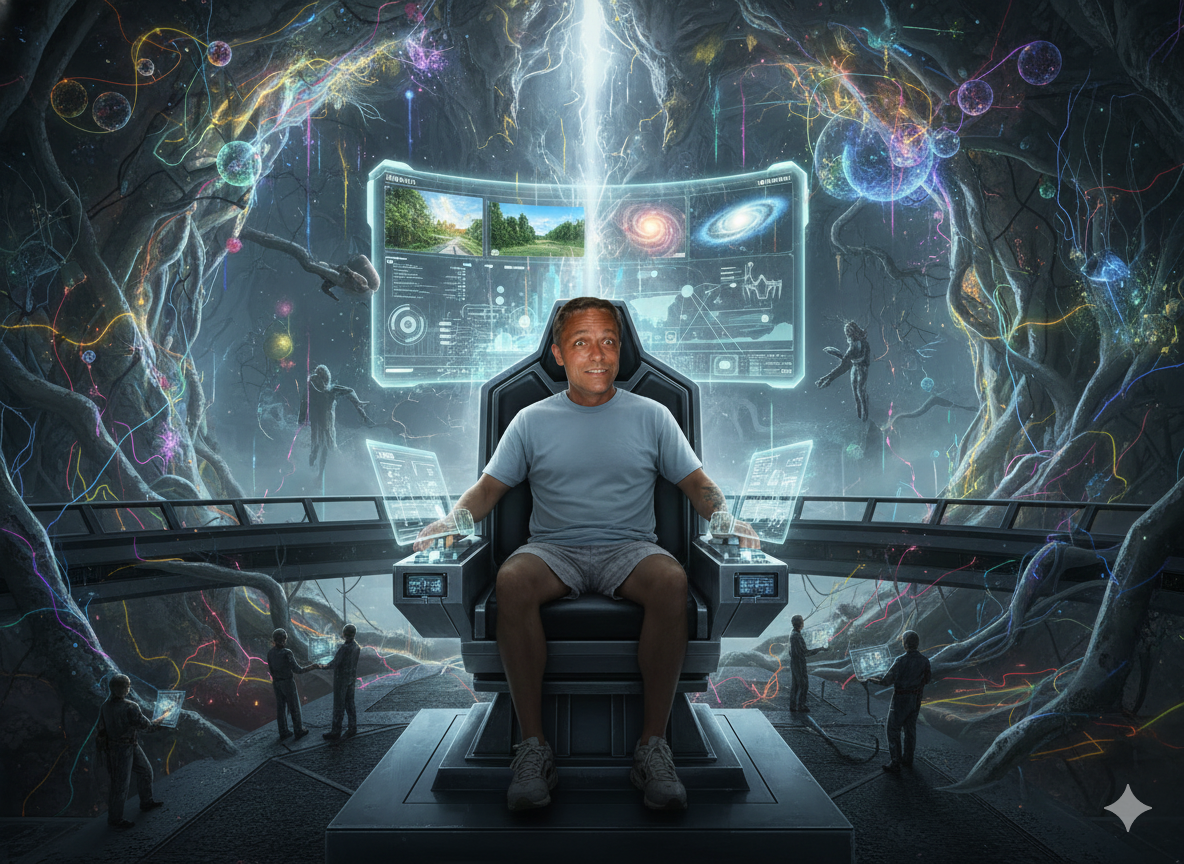
Now clearly we have a body and a brain, so no one is denying this reality. But the feeling that there is a ME inside my brain, like some homunculus running the show, is an illusion. You may be thinking, as I used to, what a bunch of bullshit. I really struggled to get my mind (brain?) around this idea, but I just could not really grasp it (though instinctually I suspected there was some veracity to the notion) until I heard Sam Harris say this:
"The feeling that there is an I or a Me up there in my head in the captain's chair is, like all the rest of it, just an appearance in consciousness."
It is not real. It is an illusion.
It is nothing more than a virtual reality construct generated by the 85 billion brain cells all yacking at each other through their 100 trillion connections.
So, if you have read this far, you may be thinking "so what? Who cares?"
The fact that the sense of a self inside our brains is in fact just another appearance in consciousness gives us the key to the door that will unlock mental freedom, from the self.
It all boils down to this: are you a slave to your thoughts, emotions, and stories roiling around in your head, or do you have the key to the door of conscious awareness that will, at any time, help you detach from all of it and see it for what it all is: simply appearances in consciousness.
The same is true for the illusion of an I upstairs in the dark, silent vault of your skull. Are you a slave to YOU, this thing called ego, that is nothing more than a neurologic virtual reality construct whose mission is to protect you? Do you have the key to the door of conscious awareness that will allow you to detach from the seriousness of YOU and allow a lighter touch with the world and with yourself?
Stepping up onto that "mental balcony" is arguably the most transformative shift a high-performer can make. It transitions you from being the protagonist struggling within the drama of living to being the director observing the stage.
When you shift from being your thoughts to observing them, you break the "spell" of the ego. Here is a breakdown of the benefits of developing this conscious awareness, categorized by general mental mastery and the specific dismantling of the ego.
Benefits of Conscious Awareness
- Widening of the "Gap"between stimulus and response. Instead of a knee-jerk reaction to a stimulus, you gain the "milliseconds of freedom" required to choose a deliberate action. As Viktor Frankl said: “Between stimulus and response, there is a space. In that space is our power to choose our response. In our response lies our growth and our freedom.” With practice not only can you get more space or time, but you can actually become more and more immune to the gravitational pull of the endless triggers and stimuli coming in.
- Less enmeshment with one's emotions: By observing an emotion (e.g., "I am noticing a feeling of frustration") rather than identifying with it ("I am frustrated"), you adopt a third party perspective on the emotion and the enmeshment with it diminishes. It's only another appearance in consciousness. To be clear: the emotion, especially very strong negative ones, are still very, very unpleasant, but now you cease being a slave to its energy.
- Cognitive flexibility: One of the keys to resilience in general is the ability to be flexible and adaptable. This is true of physiological resilience and mental resilience. Awareness allows you to see the "stories" your brain is narrating in real-time. This makes it easier to pivot when a specific mental model or strategy isn't serving the current reality. You get to decide what story you want to tell, about anything or anyone! You can decide to see people in a different light. This is a huge deal and it plays a huge role in one's mindset.
- It puts a cap on our tendency to ruminate: Ruminating on the past or worrying about the future is metabolically expensive and it causes unnecessary stress. Stepping into the present moment via awareness cuts off the fuel supply to these "background programs."
Benefits of Detaching from the I or Ego ("The Virtual Simulation")
- You are not the center of the fucking universe: Seeing the "self" as a simulation helps you realize that not everything is a personal affront. You stop interpreting external events solely through the lens of how they affect your emotions, status, or image.
- Less defensive: When you realize the "ego" is a construct you’re protecting, you become less defensive. This opens the door to genuine feedback and learning, as there is no "homunculus" whose feelings need guarding.
- Freedom from "Shoulds": The ego lives on expectations and comparisons. Detaching from it allows you to see reality as it is, rather than through the distorted filter of how you think things "should" be to satisfy your identity.
- Greater empathy and connection: Once you see your own "self" as a mental simulation, you recognize the same process in others. This fosters deeper compassion because you see their "ego trouble" as a systemic glitch that all humans are "blessed" with, rather than a personal flaw.
- Resilience against failure or setbacks: If there is no fixed, precious "me" at the center of the experience, then a setback is just a data point in a process, not a terminal judgment on your worth.
- Recognition of impermanence: You begin to see that all mental events are "evanescent" and are simply "coming and going" appearances in consciousness. All of life is like this, and really seeing this every day leads to a much lighter touch with everything.
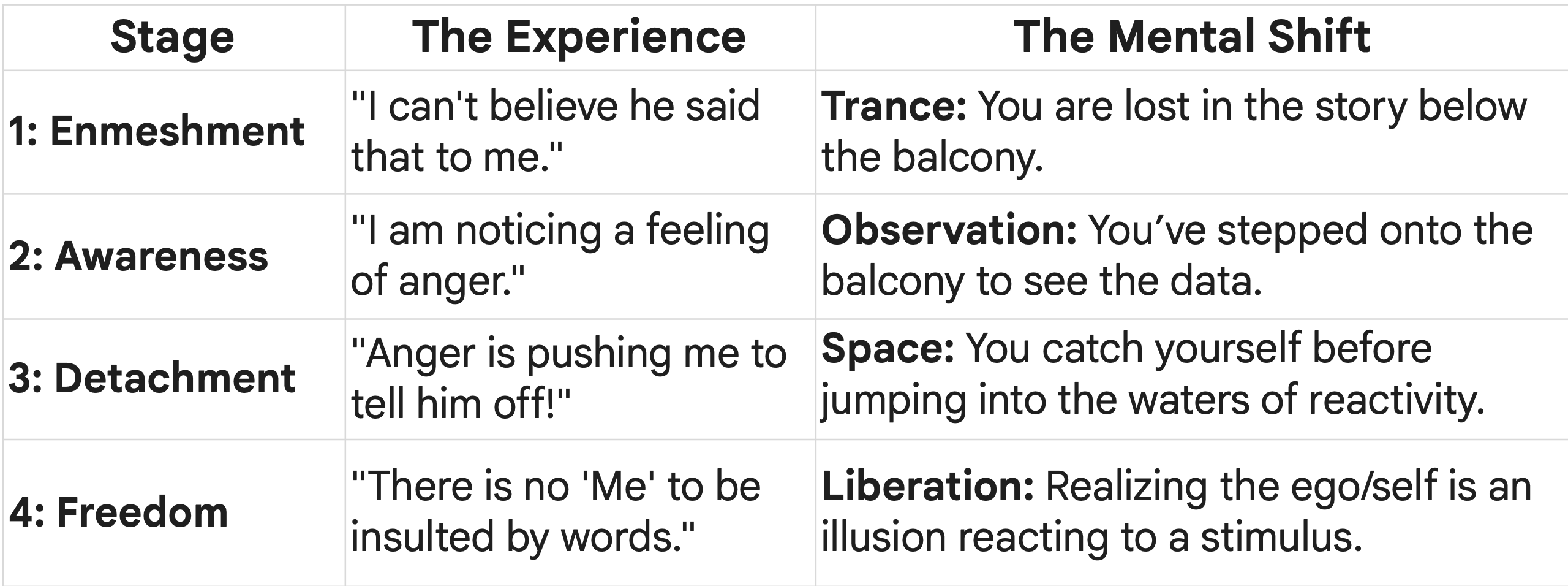
The "Mental Balcony" Map: From Striving to Simply Opening the Door.
I now turn to the how of developing Conscious Awareness.
As you may know from previous posts, we are in Los Angeles for three months. We rented an Airbnb in the West Hills neighborhood. Dogs are ubiquitous and often kept in yards cordoned off by large hedges or brick walls and fences. In the alley behind our Airbnb, there is a house with a tall brick wall and a metal door sealing off its backyard, and it has a dog who appears to live there 24/7, as if it's solitary confinement. Whenever you walk in the alley, the poor dog starts barking and scratching wildly on the metal door, to no avail.
When I was on the cushion for an hour a day, striving to get somewhere, I was like the dog trapped in the yard frantically barking and scratching at the door, desperate to get outside to some semblance of mental freedom. I thought if I just scratched long enough—if I sat on that cushion for an hour a day and "attacked" my practice like a duck breast—the door would eventually give way.
But as Harris points out through the lens of Dzogchen (a form of Indo-Tibetan Buddhism that focuses on simply recognizing the natural state of mind and conscious awareness), the door isn't locked, and you don't need to claw through it. You just have to realize that the handle is right there. Instead of scratching, you simply put your paw on the handle and pull it down.
That "handle" is always there, waiting to be discovered. Developing the ability to pull the handle and open the door to conscious awareness is not a "project" to be conquered with grit; it is a skill of subtle redirection. Think of this as your training manual for learning how to pull the handle rather than scratching at the door.
My biggest recommendation? Download the Waking Up app and dive in to the process Harris has created. It may change your life.
Below are a few additional practices.
"Closed-Circuit" Reps and Daily Awareness
- The "Spot the Minion" technique: Throughout the day, set a random timer or use recurring moments or triggers (such as washing your hands) to stop and observe your mind for 10 seconds. Doing this as much as possible is huge.
- Label the appearance: When you notice a thought or emotion, silently name it: "Story about tomorrow" or "Feeling of irritation". This act of labeling is the precise moment you go from a first person view to a an observer and you step out of the "trance" and up onto the "balcony".
- Detecting when your mind is a clenched fist: Notice when you are grinding away, striving, or clenching your teeth over something. The moment you recognize the striving, you have already won the rep; simply let go of the effort and observe the tension itself, and relax.
Strengthening the Observer
- Expanding the gap: When a triggering stimulus occurs (a surgical complication, a late colleague, a heated email), pause to see the data pouring in through your senses before you react.
- Observing the evanescence: If you do meditate, practice picking one "minion" of a thought and watch it until it disappears. This allows you to see for yourself that thoughts are impermanent "comings and goings" breaks their authority over you.
- The "Camera" perspective: Practice looking at your surroundings as if you are a closed-circuit camera, including your own body and thoughts in the frame.
Dismantling the Simulation
- Looking for the "Captain": Periodically ask yourself, "Where is the 'I' that is thinking this?" When you look for the "Me" in the Captain's chair and find only more thoughts, the illusion begins to dissolve.
- Applying the "Lighter Touch": When your ego feels threatened or judged, recognize that "YOU" is just a neurologic virtual reality construct doing its job. This detachment allows you to treat "Michael Maddaus: Master Chef" (or Surgeon) as a role you play, rather than a terminal reality.
Here is a table showing the stages of "enlightenment."
The Progression of Mastery
There you have it from the balcony of Michael Maddaus's mind!
