
The Identity Closet
NOTE: I hit publish on this piece accidentally yesterday. I am not sure how many of you have received it, so I am publishing it here again.
Here is the piece:
I was fresh out of an inpatient 3-month stint in Hazelden for prescription narcotic addiction, and Lea and I were sitting on the front porch in the early warmth of spring, "chatting" about our future.
Sounds nice, but it was anything but nice. I felt like I was on the deck of the Titanic just after it ran into an iceberg, trying to control the flames of panic inside me so I could figure out what the hell to do to rescue myself and my family.
When I was 7 years old, I found a 10-dollar bill on the sidewalk and, given that I loved Fritos, I beat cheeks down the street to the corner grocery store and came out with a brown paper bag full of yellow bags of Fritos. I sat down on the stoop at the back of our apartment building and shoveled one Frito corn chip after another down my gullet until I was packed as full as a goose in France being force-fed for Pâté.
The thick glue-like glop of ground-up Fritos I had gorged myself on suddenly became unglued, and in a flash, I auditioned for a role in The Exorcist as the ground-up glop of glue-like Fritos came spraying out of my gullet like a fire hose all over the driveway in front of me.
I haven't eaten a Frito in 64 years.
Why am I telling you this story? Because whenever I thought about returning to the University, it felt like my Fritos moment. Something I loved so much had turned into something I could barely tolerate the thought of without becoming sick to my stomach. I was done, in my heart and soul, and no matter what intellectual frosting I tried to spread over my "work Fritos," I could still smell and taste them, and my soul kept spitting them out.
So Lea and I are sitting on the porch, in the warm May sun, and the elephant in our shared mental room - my future at the University - was sitting there with us on the porch, but we both pretended for as long as we could, as if the pachyderm was not there.
Lea has a tendency to bring up elephants in a direct and forceful way, and today was no exception when she declared, seemingly out of the blue: "I don't want you to go back to the University."
It felt as if someone had plunged me into an ice plunge. I felt panic and could hardly breathe. Panic because I was being forced to confront the elephant on the porch in front of us, panic because I knew in my soul that going back was impossible, and panic over a deeper, more existential issue: that Lea and the kids would no longer love me if I wasn't a high-profile "successful" surgeon, for that is the only way they have ever known me.
I tried something new, despite the immediate and formidable pressures squeezing me like a junk yard car press machine. I told Lea my deeper truth, my deepest fear, out loud, but in a mousey way: "I'm afraid that if I am no longer this high-profile successful surgeon that you and the kids will no longer love me."
Her response? Her eyes narrowed into laser beams, and once they found their target - me - she said: "That's ridiculous."
Her declaration wasn't followed by any small reassurances like a hug or a kiss. But as Brenè Brown says, "Clear is kind."
I Become a Nobody
So I went with it.
The next day, I stepped outside with my cell phone to make the call so I could do it in private. I started walking slowly down the sidewalk, dialed the chair's office, and once on the line, and after the vacuous "how are you" question (the gap between the superficial intent of that question and my reality was as wide as the Grand Canyon), I vomited the words out:
"I've decided not to come back to work."
He thanked me, wished me the best, and we hung up.
The call lasted as long and was as perfunctory as a call to a grocery store to see if they have any ripe mangos in stock.
A one-minute phone call and 38 years of the life I had built one brick at a time was over. I felt as if I was back on the stoop in the back of my apartment building, fighting the waves of nausea and urge to vomit on the sidewalk in front of me.
When you puke up a wad of Fritos, you feel better right after.
Vomiting on the sidewalk would not have given me any relief for the loss I was about to experience. The loss of my Identity.
Before the phone call, I was a surgeon.
After the one-minute phone call, I became:
A nobody.
I had spent nearly 30 years filling my mental closet with one outfit.
Surgeon.
Each item in my One Identity Closet was added one piece at a time.
"Dr. Maddaus," Assistant Professor, Associate Professor, Full Professor, committees, Division Head, master minimally invasive surgeon, the Winston Wolff of Thoracic Surgery, journal editor, endowed chair, Vice Chair. I unconsciously put on one piece of the outfit at a time until the whole outfit fit like a dream, until I forgot it was clothing at all.
It became the skin that kept my insides tidy. The "I" in my brain merged with the outfit.
Now I was naked. Like a newborn. Without even a diaper.
The elephant reared its head and ears whenever I came face-to-face with people. If I didn't know them and they asked the usual "what do you do?" question, I had no idea what to say. Or if I did know the person and had to answer the ubiquitous and annoying "what's new with you" question.
Am I still a surgeon? Am I still a doctor?
This is not a "silly issue." It is one of the most disorienting questions a human being can face. When the outfit is gone — stripped away in a one-minute phone call — the self has nowhere to attach. You float.
The Neutral Zone
The next step in the unwinding of my identity house of cards? Clean out my closet. My real closet.
With a large plastic garbage bag in hand, I stepped into my side of our bedroom closet and did what Marie Kondo advises in her book The Life-Changing Magic of Tidying Up.
I picked out the things I was going to throw or give away, and I had a little ceremony to honor their place in my life.
I had a stack of blue scrubs, which I wore to work nearly every day. I picked up the stack of blue tops and bottoms, my favorite outfit of all time, and held the pile in my arms, closed my eyes, and remembered my days in the operating rooms, the good and the bad, all with the great people who were a huge part of my work family and who helped make it all happen.
I stuffed them in the garbage bag.
Then my white coats. The ones with the custom red letters sewn on that said:
Michael Maddaus, MD
General Thoracic Surgery
I held them like my scrubs and remembered the pride I felt when, as an attending, I put on the long white doctor's coat with my name sewn on, and how official I felt, as if I had finally made it.
I decided to keep one of them on the rationale of wanting one for my kids, so I folded it up and put it in a drawer. I still have it and am glad that I do. The rest I stuffed into the garbage bag with my scrubs.
As I stuffed my past into the garbage bag, I broke down sobbing. It was a kind of sobbing that until Hazelden I was completely unfamiliar with, the kind of sobbing where I was gasping for air with an avalanche of snot and tears skiing down the slopes of my face.
It was the same kind of sobbing I experienced sitting on my bed in Hazelden in the middle of the night when I saw my mother and her humanity and frailness instead of her alcoholism.
My newfound sobbing skills would turn out to be the start of learning how to embrace my more difficult emotions, instead of ignoring, stuffing, and running away from them.
After I blew my nose and wiped up the tears, I walked outside, lifted the brown lid to the garbage bin, and dropped my past inside.
Done.
Or so I thought.
It turns out that "you have to survive the empty closet" before you're "done."
One day, not long after my closet therapy session, I was sitting on our orange couch in the living room, bathed in the spring sunlight, reading two books on life transitions by William Bridges, recommended by a counselor at Hazelden.
William Bridges was an internationally recognized expert in helping organizations manage large-scale human transitions, such as major layoffs and downsizing. In his book "Transitions: Making Sense of Life's Changes, he says:
“Treating ourselves like appliances that can be unplugged and plugged in again at will or cars that stop and start with the twist of a key, we have forgotten the importance of fallow time and winter and rest in music. We have abandoned a whole system of dealing with the neutral zone through ritual, and we have tried to deal with personal change as though it were a matter of some kind of readjustment.” And here is the quote that is the real kicker:
“It isn't the changes that do you in, it's the transitions.”
His other book, The Way of Transition, is about his personal life's transitions, and the key takeaway is this: in any major life event (death, moving, loss of a job, illness), the wrong thing to do is to do something to relieve the pain. The right thing to do is sit still and enter what Bridges calls The Neutral Zone, a window of time one gives to oneself to allow the emotions and chaos of such a large event to cool off sufficiently so one can then make better decisions free of the desire to relieve the pain.
Given that Bridges was a big name in the human transition arena, and given that I found myself in one of the biggest transitions of my life, I took him at his word and decided then and there to enter The Neutral Zone.
And I decided to become a house husband while in the Neutral Zone until I could "find" myself somewhere.
What I eventually discovered — and this took time — was that cleaning out my closets - my mental closet, and my clothes closet was one of the most clarifying experiences of my life. Like cleaning out the big house you bought when you finally started making money and unloading the accretion of "stuff" that filled the big house over the years.
Be Yourself Is the Greatest Lie
I recently came across a two-and-a-half-minute YouTube video (inserted below) by Celastrina Calea that triggered this piece, which, as you can discern from the above story, I had to learn the hard way. Here is an excerpt:
"Be yourself is the greatest lie you were ever told. You weren't born with an identity. You were born with potential. But potential cannot be controlled. Labels can." And then this:
"The word identity originates from the Latin idem and identidem, and literally means 'a repeated beingness.' Your identity is not who you truly are. It's the version you repeat often enough that it becomes your truth."
A repeated beingness.
That's what I'd been doing for twenty years. I was a surgeon so consistently, so completely, so publicly — that I had confused the repetition with the reality. I wasn't wearing the clothes anymore. The clothes were wearing me.
Celastrina doesn't let us off easy:
"The moment you say, 'this is just the way I am,' you're defending the bars of your own cage."
That's the thing about a well-stocked identity. It can become a cathedral you worship in. The bars are gilded, but they are still bars.
The Annie Duke Layer: Why We Can't Let Go
Annie Duke wrote an entire chapter on Identity in her book Quit — titled, appropriately, "The Hardest Thing to Quit Is Who You Are."
Her conclusion: "When it comes to quitting, the most painful thing to quit is who you are."
Why? Because of how identity interacts with what psychologists call cognitive dissonance — the discomfort of holding a new belief that contradicts a prior one. When the identity itself is the prior belief, abandoning it doesn't feel like updating your thinking. It feels like annihilation.
Duke's most ruthless line: "We are all in a cult of our own identity."
I've coached enough people now to know she's right. We don't just wear the clothes. We can end up worshiping them.
I have had the privilege of coaching a prominent academic surgeon who was fired as division chief at a prominent academic institution. The position he'd held was the kind that defined you at cocktail parties and at the academic surgical meetings.
His immediate reaction: update the CV, reach out to contacts, and find a new job. All driven by fear, uncertainty, embarrassment, and shame, the very emotions Bridges admonishes us not to run from by entering the Neutral Zone.
I told him to stop.
His identity — "division chief," "academic leader," "the man at that institution" — the identity clothes he was wearing had just been ripped off, and his instinct was to fill his nakedness with a new outfit like the one just ripped off, as fast as possible.
Instead of the abstract notion of the Neutral Zone, I operationalized the process with a term I love: muscular patience. Not passive waiting. Active, disciplined stillness in the face of enormous pressure to act. This is a superpower in general, and it is the apex skill of the Neutral Zone and the core of contending with a major life disruption.
He flexed his muscular patience muscle, and after multiple job interviews and resisting the temptation to just "take something" to get away from the past and feel secure again, he waited, and persisted, and waited, and persisted, until nearly two years later he found the right position. Not a job — the job. One that fit what he wanted in a job and career, not one defined by the gravitational force of an identity.
The Neutral Zone and his muscular patience allowed him to air out his mental closet so he could see the pieces that mattered most to him: working with colleagues and a team he cared about, the ability to do big, complex cases, and to continue his academic writing and teaching, especially the teaching of residents. He realized that he valued that more than any title or position.
The neutral zone isn't empty time. It's the most important work you'll do when the shit hits the fan.
True Liberation
Here's where the video nails it: the goal isn't to destroy your identity.
It's to stop worshipping it.
Celastrina says: "True rebellion in our society isn't changing your identity into some spiritual, rebellious stereotype. It's realizing your identities are clothing you can take on and off... You're not a character of the story. You're the author."
You're the author.
Now that's agency. You drive your identity instead of it driving you.
That's what the sidewalk eventually gave me — against my will, through genuine pain, and not on any timeline I would have chosen. Just like my coaching client who was fired, leaving work forced me to open the closet, look at everything hanging there, and ask: what do I actually want to wear? Not what was handed to me. Not the stuff I wore for so long that it became my skin.
But what do I choose to put into my new Identity Closet??
Here are a few sartorial pieces I tried on early:
Househusband. Lea was still working as a high-risk obstetrician, and we had two daughters in school - one in high school and one in middle school. I took over all of the household chores and management. Turns out I was a little too good at it, since when Lea came home from work one day she plopped down in a chair, looked at the flowers on the table and the spic and span house and the dinner cooking in the kitchen and started bawling (not the snot like bawling of mine) and said: "I guess I'm just not needed around here anymore." She ended up adjusting very well once she got out of the - drum roll - Neutral Zone!
Engaged father. I mastered the art of banana bread by perfecting the perfect recipe, assembling it, putting it in the oven, then driving to pick up Anne at school, and voila, the moment we enter the house the smell of fresh banana bread flooded my little girl's nasal passages and brain, and she ate her warm snack with delight. Or when Maya was elected swim team captain, and I was responsible for going to Costco to pick up snacks for the team to eat after practice. I was actually engaged instead of just showing up. When at the team meeting, they announced that Maya was the team captain for the season, I was standing across the room, and she walked over to me, put her arm in mine, and squeezed it, with everyone looking at us. Nuff said.
Surgical confidant. Not long after I was discharged from Hazelden, I started getting phone calls from several of my colleagues and former residents who wanted to get together for breakfast. I figured they were just doing this out of sympathy for the predicament I found myself in. But it turned out they wanted to get together to talk about their own personal struggles and things that they could never reveal to anyone else. I was stunned. I figured I had nothing to offer anyone anymore. Not only did they value my perspective, but they sought it out. This was the start of my entire coaching career. When I realized that I had something else of value to offer others, and that I LOVED doing it, I eventually put on the outfit.
Those are a few examples of clothes I added to my Identity Closet I still wear to this day. But I have several other pieces in my Identity Closet: husband, father, coach, writer, speaker.
But the best new piece of clothing I put into my Identity Closet?
Human Being. Yes human being, because getting stripped down naked by leaving my academic and clinical career left me stark naked, and it was then that I understood the truth: that we are all human beings first, and being able to return to that place is really ground zero.
Oh, and by the way, I am still a surgeon. The incredible skills in all arenas of life that my career gave to me are alive and well. But they are only one outfit in my new tidy Identity Closet.
The video's final line:
"True freedom begins the moment you stop worshipping and protecting an idea about yourself that wasn't yours to begin with."
A Question for You.
What's in your closet?
Not the professional bio. Not the LinkedIn headline. The actual closet — the identity you may have been wearing so long you've forgotten it's a choice.
Is it "I'm not a feelings person"? Is it "I don't do conflict"? Is it "I'm a surgeon" — or a CEO, or a caregiver, or the strong one?
Some of it fits beautifully. Keep it, wear it, but know when to change outfits. In the earlier pre-Hazelden version of myself, my surgeon identity permeated nearly every aspect of my life, including how I interacted with my family.
But some of it? Maybe you haven't worn it in years. You just keep it because getting rid of it feels like losing yourself.
It's not.
It's finding yourself.
Here is the video that sparked this piece:
Post Script:
Keeping the coat and throwing the rest in the garbage is interesting because my powerful tendency in the past was to completely obliterate the past - what's done is done - and move on. But this kind of black and white thinking is not good.
We are in Los Angeles visiting three of our kids who live together in a house, and Lea wanted to find some lamps for their house. Out shopping, we strolled by an antique store and happened to see two beautiful lamps in the window, and I was drawn to them immediately.
It turns out they're from the 1930s and they're made from what is called Bristol glass, which is a type of semi-translucent glass made in Bristol, England originally, and then popularized as milk glass in the United States. What drew me to the lamps in the store window were the beautifully painted leaves and vines on the glass.
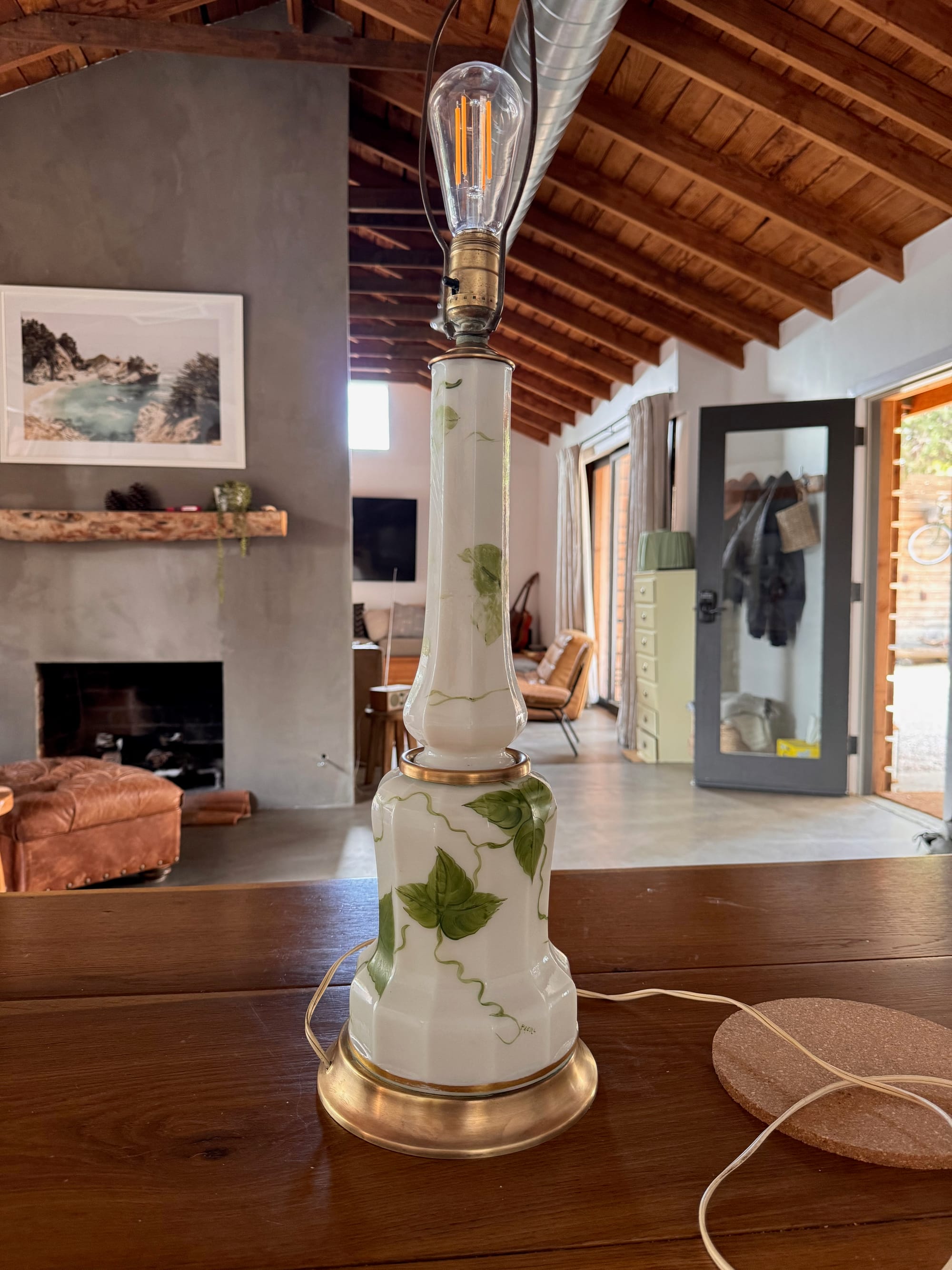
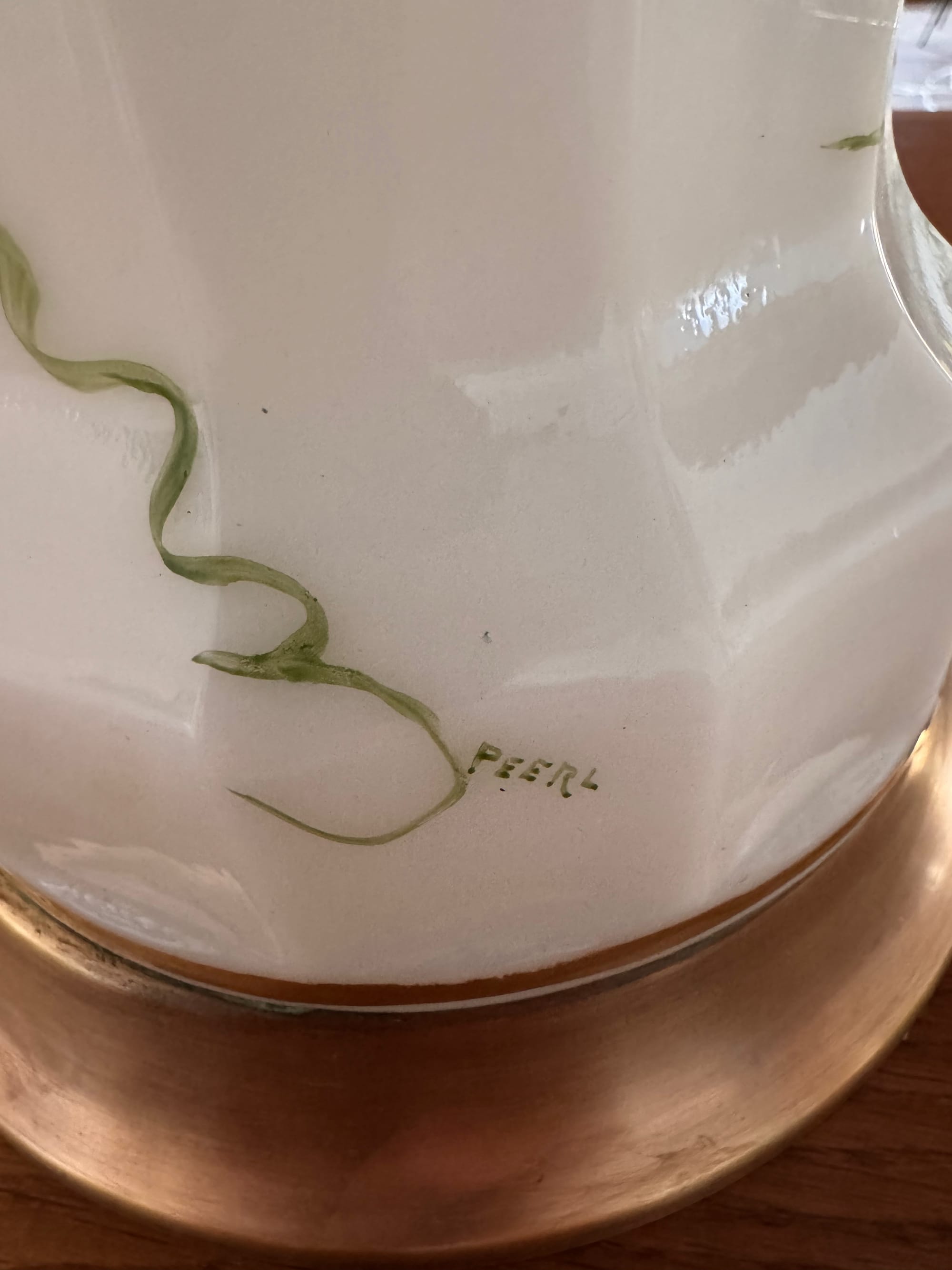
While I was cleaning the brass rings on the lamp, I happened to notice that the person who painted the vines and leaves signed the lamp in two places with the name Peerl. I looked up the story behind Bristol Glass and the lamps and the artist Peerl. Turns out Peerl was almost certainly a very talented artist who worked in a lamp factory in the1930s. But because she was so good at painting these hand-painted items on the lamp, she was, unlike the other artists, allowed to sign her name.
The point is, we don't want to delete the past. We want to remember it in a way that honors the person and the situation. Seeing the name Peerl and the story of the lamps lit up my soul, because of the human story and human artistic endeavor. I am sure the lamps will mean so much more to our daughters because of the rich human history of them. In a similar vein, I believe that by keeping my white coat and writing these stories that my family will have the texture of my life that will light up their soul, and their children's souls, in the future. At least I hope so!
